|
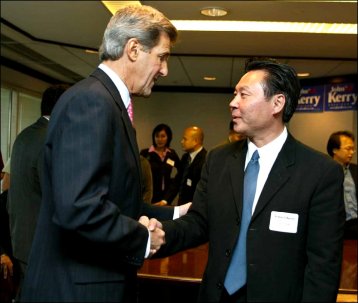
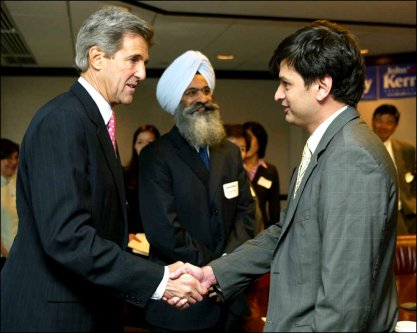
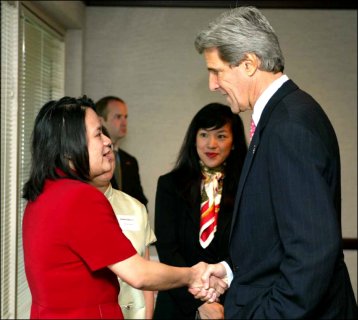
Washington, DC - Democratic presidential candidate John Kerry met with members of the Congressional Asian Pacific American Caucus (CAPAC) and other Asian Pacific Islander American (APIA) leaders to discuss educational opportunity and other issues of importance to the community. Kerry outlined his strategy to mobilize APIA voters and criticized George Bush for ignoring the concerns of the APIA community. He also praised the many contributions of the APIA community in celebration of Asian Pacific American Heritage Month.
"Since the earliest days of our country, Asian Pacific Islander Americans have made a positive impact on our country and have been a beacon of the American dream. However, too many Asian Pacific Islander Americans have been forgotten by the Bush Administration," said John Kerry. "Today's meeting with Members of Congress, state and local elected officials and APIA leaders was a great opportunity to share our common vision for an America that celebrates diversity, embraces inclusion and opens doors of opportunity. I look forward to our continued dialogue as we work together to build a stronger America.
During the one-hour meeting, John Kerry noted that while higher education has been a ladder to success for many in the APIA community, under George Bush's administration, access to college has become unaffordable. Average tuition and fees at public four-year colleges increased from $3,487 in 2000-2001 to $4,694 in 2003-2004, a 28 percent increase after inflation. This jump in tuition has resulted in an estimated 222,000 students unable to attend college due to cost. While George Bush has turned a blind eye to the risings costs of higher education, John Kerry has proposed a comprehensive approach to tackling this issue by creating a college opportunity tax credit and simplifying the financial aid process.
Kerry also criticized the Bush Administration's failure to address critical immigration issues and the unfair treatment that many minorities of Asian Pacific Islander descent endured under Bush's immigration registration program. Kerry pledged to make immigration fairer, ensure family reunification as a priority and implement policies that respected civil rights while maintaining security. He also stressed his support for reinstating benefits to legal immigrants, many of whom are Asian Pacific Islander American seniors.
"This meeting reinforced our belief that John Kerry is the best presidential candidate for the APIA community, and indeed, for all Americans. He has demonstrated that he understands the needs and concerns of this community," said Congressman Michael Honda, Chair of the Congressional Asian Pacific American Caucus. "I know everyone at the meeting and in the APIA community at large is committed to doing everything in their power to make John Kerry our next president."

In addition, John Kerry voiced his alarm over the recent Executive Order that drastically reframes and restricts the White House Initiative on Asian Americans and Pacific Islanders. The original Executive Order issued by President Clinton had a broad mandate to "improve the quality of life of Asian Americans and Pacific Islanders through increased participation in Federal programs where they may be underserved (e.g., health, human services, education, housing, labor, transportation, and economic and community development)." The Executive Order signed by George Bush on May 13, 2004 narrows the mandate to focus principally on business and forgoes previous collaboration between government agencies.
Kerry stated his support to reinstate the mandate laid out in the original Executive Order and indicated the need for data collection and cross-agency collaboration on numerous Asian Pacific Islander American issues. Kerry also praised the efforts of the many APIA organizations that worked together to produce the report, Call to Action: Platform for Asian Pacific Americans National Policy Priorities, and expressed his agreement with many of the principles and policies outlined in the report.
|