President Bush Has Spent Years Working
Towards An Energy Policy:
President Bush: "Four Years Ago,
I Called For A National Energy Plan To Address Our Nation's
Energy Needs For The 21st Century. The Bipartisan Energy
Bill Passed ... Will Give America A Comprehensive National
Energy Strategy For The First Time In More Than A Decade
And Is Critically Important To Our Long-Term National And
Economic Security." (White House Press Office, "Statement
By The President," Press Release, 7/29/05)
In 2004, President Bush Campaigned On
Energy Reform: "We Need An Energy Plan To Keep Jobs
Here In America. We Need To Become Less Dependent On Foreign
Sources Of Energy. ... I Am Going To Get It Done."
(President Bush, Remarks By The President In "Ask President
Bush" Event, Columbus, Ohio, 8/5/04)
Partisan Senate Democrats Have Spent The
Last Four Years Obstructing The Passage Of An Energy Bill:
"The Senate Has Been The Graveyard
In The Past For The Energy Legislation That President Bush
Has Sought Since Taking Office In 2001." (Ben Evans,
"House Ready To Debate Energy Bill," Congressional
Quarterly Weekly, 4/16/05)
In November Of 2002, Senate Obstructionists
Refused To Send The House A Bill Out Of Conference, "Effectively
Killing The Legislation." (Colin Sullivan, "Senate
Conferees Vote To Kill Energy, Punting Issue To Next Congress,"
Environment And Energy Daily, 11/14/02)
In November Of 2003, Obstructionists In
Senate Defeated Cloture Motion, Killing Energy Bill For
2003. (H.R. 6, CQ Vote #456: Motion Rejected 57-40: R 44-7;
D 13-32; I 0-1, 11/21/03)
The Energy Bill Will Create Greater Energy Security And
Boost The Economy:
Tax Benefits For Traditional And Alternative
Fuel Sources: "The [bill] ... [will] provide $14.6
billion in tax breaks and credits between 2005 and 2015.
Of that, about $9 billion targets energy infrastructure,
including $1.6 billion for clean coal plants and $2.7 billion
to extend the renewable electricity production credit. The
bill also [will] provide $2.8 billion for fossil fuels,
$1.3 billion for conservation and efficiency and $1.3 billion
for alternative motor vehicles and fuels." (Ben Evans,
"Key Provisions Of The Comprehensive Energy Bill,"
CQ Today News, 7/28/05)
Nuclear Energy: "The Bill [Will]
Bolster Security Requirements For Nuclear Plants And Extend
Through 2025 The Price-Anderson Act (PL 85-256), Which Caps
The Industry's Liability For Catastrophic Accidents."
(Ben Evans, "Key Provisions Of The Comprehensive Energy
Bill," CQ Today News, 7/28/05)
"The Nuclear Industry -- Which ...
Has Not Ordered A New Nuclear Plant Since The 1970s -- [Will]
Garner New Federal Support To Help Get New Reactors Built."
(Adam Satariano, "No Senate Filibuster Seen On Energy
Bill," Congressional Quarterly Green Sheets, 7/27/05)
Conserving Energy And Boosting The Economy
Through Daylight Savings: "The Legislation [Will] Extend
Daylight-Saving Time By One Month Beginning In 2007."
(Ben Evans, "Key Provisions Of The Comprehensive Energy
Bill," CQ Today News, 7/28/05)
The Washington Post: "[A] Provision
In The Energy Bill Would Extend Daylight Saving Time By
Three Weeks In The Spring And One Week In The Fall Starting
In 2007, Conserving Energy And Perhaps Preventing Some Crimes
And Traffic Accidents... [I]f More Daylight Means More Consumer
Activity, That's Good For The Economy." (Editorial,
"EDT Plus," The Washington Post, 7/28/05)
Energy Efficiency: "The bill [will]
direct the National Highway Traffic Safety Administration
to study the effects that increasing fuel efficiency standards
for cars and trucks would have on the auto industry, the
supply of gasoline and the environment, but it does not
mandate any such increase. The bill calls on the Energy
Department to set stronger efficiency standards for various
commercial and industrial appliances and products."
(Ben Evans, "Key Provisions Of The Comprehensive Energy
Bill," CQ Today News 7/28/05)
"The Bill [Will] Provide Numerous
Incentives To Encourage Conservation And The Development
Of New Technologies Such As Hydrogen And New Hybrid Cars."
(Adam Satariano, "No Senate Filibuster Seen On Energy
Bill," Congressional Quarterly Green Sheets, 7/27/05)
Electric Reliability: "The
Measure [Will] Strengthen Federal Authority To Enforce Reliability
Standards For Electricity Transmission Networks." (Ben
Eva ns, "Key Provisions Of The Comprehensive Energy
Bill," CQ Today News, 7/28/05)
|
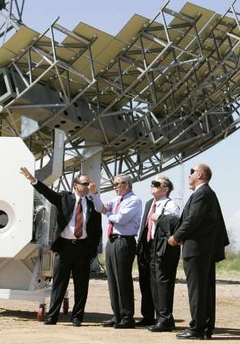
U.S. President George W. Bush
(2nd L) speaks with lab Director Thomas Hunter (L) during
Bush's tour to the National Solar Thermal Test Facility at
Sandia National Laboratory in Albuquerque, New Mexico, August
8, 2005. Bush travelled to the state to sign the new $14.5
billion energy bill which was passed by Congress after a four-year
battle. |


