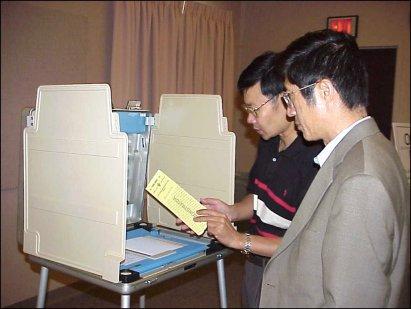
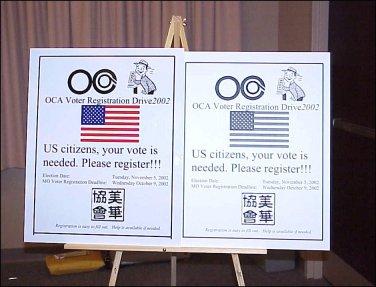
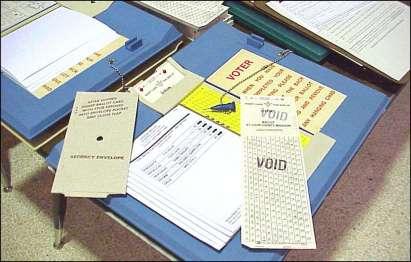
It is that time of the year-political campaign season. You may have seen political campaign signs of various candidates running for government offices.There are two critical issues that we hope that Chinese Americans as well as other Asian Americans should be aware of. One issue is to be aware of the importance of voting at such a time, and another issue is whom we should vote for. In the following sections, we will discuss these two issues.First, why should we care about voting? Although the reasons for voting have been discussed at various occasions, it may not dawn to you the importance of voting, particular for people like you-a member of minority group without political power. Thus, we want to mention some of these reasons again in hope that you can truly appreciate the importance of voting to you.Since many times most Asian Americans view voting as an "elective" activity, and do not pay any particular attention to politics around them, we want to point out that this is a gross mis-calculation on your part. Although there are many reasons can be enumerated with respect to why Asian Americans are so indifferent to voting, we want to emphasize that no matter whatever the reasons you may have, there is compelling evidence to indicate otherwise. Let us discuss some of the evidence and hope that you become more educated.
1. Politicians decide how much tax you should pay for items you buy or you own. That may include food you put into you mouth, clothes you wear, or house you live in. The list goes on and on. Since you have practiced this so long, you may not even notice it anymore. For Asian Americans with limited incomes, that translates into what you can eat, wear, or live. If politicians like, they can put a cap on the gas price. Whether they will do that or not, it is not the point. The point is that you are not in control.
2. City council has constructed flowerbeds on the road in your neighborhood (maybe with good intentions). That comes out of your tax dollar money. Whether you like it or not, it is beyond your control.
3. Maybe more personal matter-immigration issue. Politicians decide who can come, or when your relatives can come. At one point in time, we all experienced it.All these issues are or can be institutionalized by politicians in the form of law. Whether you like it or not, it is beyond your control. That is why you often hear the phrase "powerful politicians". Why are they powerful? Because they are in control. They decide what your life should be.However, they have one "deadly" weakness, although politicians are in control and powerful. That is, they need you, or be more precise, they need your vote to be in charge. This is true regardless who they are or whatever political issues may be such as issues about school your children attend. That is the power you have--voting. When you do not use this voting right, this implies that you does not count, or be cruel, you are nobody, at least in the eyes of politicians. This is particularly true for minorities, and especially so for Asian Americans.If one vote does not matter too much to politicians, then one hundred votes will. Remember that 100 votes is equivalent to about 1000 dollars they may get to spend on their campaign. If we can deliver 2,000 votes as an Asian American group, not a big number, at local, state, or national level (i.e., vote on senators), politicians would consider us as their best friend. Think about what a best friend can do for us. Your best friends would help you to change what you don't like.Now let's turn to our second issue-whom we should vote for. This issue is more personal, but there are some critical lessons that need to be learned.The easiest thing in voting is to vote along a party line. If you are a democratic or republican, you could simply vote for candidates or issues that are advocated by that party, regardless of issue. However, voting along a party line is more or less like blind voting. Not all candidates from any party are good or bad. Similarly, t all sues raised from a party are good or bad. Thus, if we vote along the party line, that means we are not doing our own thinking.Maybe a right thing to do is to list issues that are important to us and then vote according to the issues. For example, if a candidate, regardless of which party he belongs to, has ten issues or ideas that are consistent with ours, but another candidate has only eight issues or ideas that are consistent with ours, then it makes more sense to vote for the candidate who is agreeing with us more, not the party affiliation.However, there is one catch that we also need to be aware of-minority group membership. Whether we like it or not, we are Asian American. Thus, for the sake of group membership, we may need to trade some issues. For instance, if one candidate has ten issues that we are supporting, and another candidate has eight issues we are supporting, but one of the issues is important to Asian Americans, then we may want to vote for the candidate that are more pro-Asian American. Although this is not the ideal situation, this is reality-vote for group interests that you are a part of.In this article, we discussed two important issues regarding voting. You may not agree with what we are saying here, but the point is to have you go out to vote and vote in a smart way.
Editor Note:
"OCA-STL Column - a monthly column with topics that concerns ourcommunity. We'll also accept any appropriate questions or topics thatyou want us to discuss. They can be forwarded to Eling Lam atcommunications@oca-stl.org" |