 
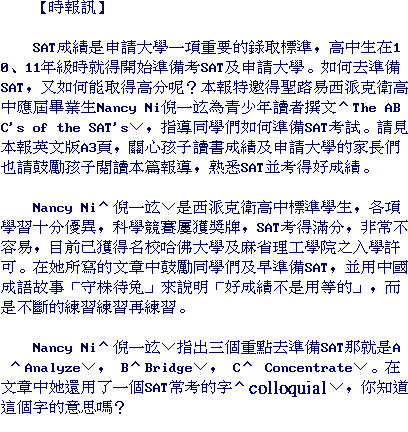
The ABC's of the SAT's
"You may now begin the test." The infamous words of initiation into the SAT. If you want to prepare well for the SAT I, don't wait until test day to hear those words. 'Begin' should have begun long before the test itself. The SAT I tests your math and verbal skills. Gasp, but math and English do share something in common. The SAT I is an evaluation of how well you can analyze, bridge, and concentrate, whether in math or verbal reasoning. Say what?! Ok, set those areas aside for now (or for you lean-meat-only folk, skip ahead to the next bold words). Just to take the test, disregarding scores and what not, you need to get some basics first. Start off by finding out (1) Format of the test (what are the sections? how long is each section? Can calculators be used? If so, which ones?)
From experience, the easiest way to find out is from an SAT practice book. Better yet, refer to several up-to-date SAT practice books published by different companies, just to check the accuracy of the information you will need. I used Princeton Review, Kaplan, and Barron's. Don't depend on every word of those books. Use common sense. Learn the strategies you need in those books and don't waste time cutting out those cute but tree-hungry vocabulary cards. You can make your own vocabulary lists, which are space saving and more efficient. One more note, if you want some serious preparation for the SAT I, those computer CD study programs are not recommended. Sure the graphics are colorful and you can even choose your own tutor, but HELLO! You are not going to have that tutor with wacky hair and those absurd sound effects when you take the test. Studying on the computer is more clutter and much more time-consuming than it is worth.
Be tough; face the books.
You know the basic format of the test and the types of questions that will be asked. So now what? Practice, practice, practice. Get that mantra in your head. There's this Chinese fable about a farmer who waited around for rabbits to run themselves into trees. Well, don't wait around for a good score on the SAT. Work for it by taking those practice tests. My first 'diagnostic' test was no work of art. In fact, it was like one of those anvils in Animaniacs that drops down on unsuspectingly. Discovering how much room there was for improvement helped me put things in perspective. There's a lot of work ahead, but take it step-by-step, and you'll find it's manageable. Now let's get to the ABC's of the SAT.
Analyze.
When you read someone's writing, it's not enough to know what the person is talking about. You need to understand what the person is getting at. When you analyze something, you examine its details; you look at the writing from different angles (and I don't mean reading upside down or backwards). SAT questions will ask you what the author's tone is or what a certain word means in context. Those are questions that check to see you are paying attention to the work as a whole and in specific. Make decisions based on the author's words and what you can directly tell from them. The magic wand of make-something-up-because-it-seems-reasonable will not work. Your answers must have strong support from the text. When you read, make quick notes in the margins of your test booklet, underline important sentences, and make conclusions along the way about how the author feels or what point the author is trying to establish. The key is to be an active reader. Don't be an osmosis-loving sponge.
Bridge.
Making connections is very important. If it's hard to remember the word indomitable, just imagine the Indomitable Snowman, undefeatable and enormous. How are connections made? Read a lot of different books that interest you. Even if you are not an avid reader, there must be some books out there that interest you. Again, read actively. In the verbal sections, bridge the words in the text to find the author's feelings toward the issue that he or she addresses. Bridging is very important in those double passages. You'll need to compare the two passages. How are they different? (in terms of style, information, viewpoint) How are they similar? Your answers must come from what you learn from the passages. Bridging different pieces of information together will give you a clearer picture. In math sections, bridging means piecing together given information and finding patterns that will help you solve a problem. While you do practice tests, pay attention to how you are bridging information and how you can do it better. Discover your weakest link and strengthen it.
Concentrate.
This aspect of test-taking bridges what you have prepared with the actual test experience. Get into a good habit of studying in a quiet room at a desk. Hide your radio. Learning to concentrate during practice tests will be a great advantage on test day. Test day is big, but nothing surprising since you've practiced all along. Make sure you make the most of your test by getting plenty of rest the few days before test day. Cramming information into your brain at the last minute is stressful. Don't stress out at the last minute. If you prepare hard in advance, you will do fine. Try your hardest and work at a comfortable pace. Even before the test, you've proven to yourself how well you can do by practicing a lot. Now prove it to the colleges by taking the test in the same focused way. The rest is history.
Disclaimer: Grammar in this article is not in accordance with standard written English. In fact, this article is very colloquial (look that word up right now if you don't know it already; it's common on the SAT I).
|





