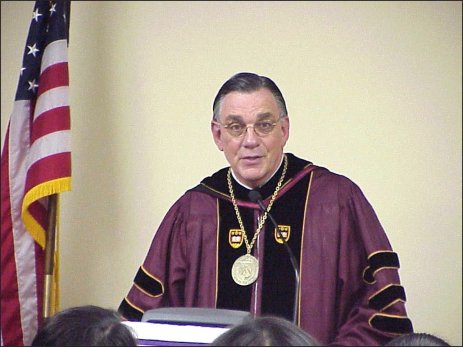
(Editor Note: This is the speech Dr. Golden made at THE INTERNATIONAL FORUM FOR UNIVERSITY PRESIDENTS ON THE CHALLENGE OF THE E-ERA FOR HIGHER EDUCATION: "GLOBALIZATION, MULTICULTURALISM, AND MODERN TECHNOLOGY" on March 22, 2002 at Ming Chuan University, Taoyuan Campus, Taipei, Taiwan)
Perhaps more so in the E-Era than ever before in the history of international higher education, there is a need for authentic presidential leadership. There is a need for person power to exceed position power. There is a need to understand that one of the major purposes of leadership is to help organizational participants develop convergence and greater consistency in their actions and their views of reality and, in doing so, bring a truce to what John Gardner has called "the war of the parts against the whole."11 Put another way, especially within troubled institutions during troubled times, presidents often have one main responsibility and that is to keep hope alive.12 In so doing, one of the best ways that I know to fully involve presidents and to empower others, especially in this E-Era, is to utilize the methods of Alexander and Helen Astin, namely the Principles of Transformative Leadership. And the Astins believe that leadership is a process that is ultimately concerned with fostering change.13
Since the 1940's, America and perhaps other nations have undergone many changes or revolutions such as an enrollment revolution, a research revolution, an adult education revolution, a student protest revolution, an international education revolution, a higher expectation and accountability revolution and now an E-Era revolution.14
Consequently, real presidential leadership in the E-Era should be people over product focused and such focus is not accidental. It is intentional and directed toward some future end or condition that is desired or valued.15 In essence, the presidential leader is one who fosters change and becomes a change agent.16 On college and university campuses, the essence of that change agency should be visionary, mission focused, value oriented, student centered, financially sound and holistically constituted with emphasis not only the student's academic development but also on his or her emotional, psychological, career, social, spiritual, health and interpersonal development.17
I agree with the Astins when they assert that by definition leadership is a collective or group process that comprises four basic assumptions:
(1) Leadership is concerned with fostering change, (2) Leadership is inherently value-based, (3) All people are potential leaders and (4) Leadership is a group process.18 The Astins emphasize that their conceptions of leadership should not be viewed as a type of final theory of effective leadership but as one of many visible and viable approaches. I believe that their approach is one of the very best for presidents to consider using in the E-Era.
In order to be both effective & efficient in the quest for people over product in the E-Era, the following five individual qualities are needed: a) self-knowledge, b) authenticity/integrity, c) commitment, d) empathy/understanding others, e) competence.19 Those five individual qualities should be combined with five value based goals namely: 1) collaboration, 2) shared purpose, 3) disagreement with respect, 4) division of labor, 5) a learning environment.20 Once the five individual qualities are linked with five value-based goals, the president becomes more than a CEO; he/she becomes a compassionate change agent. Presidents can then assess their institutions in order to determine if they are being transformed into more just, equitable, sincere, and democratic entities.21
Many times during my thirty-six year career in higher education, I have been asked to successfully explain how I know when we are doing the right things for the students. I have come to the belief that the hallmarks of a people over product educational environment are when students acquire the skills necessary to: a) think logically b) write clearly c) speak truthfully d) function effectively e) decide ethically f) and exercise a keenly sensitive social conscience.22
Yes, there are integrated E-Era learning systems and much will be accomplished through the utilization of this advanced technology. But all of the data inputs originate with people, and all of the results must be understood and utilized by people. Therefore, I believe that the Principles of Transformative Leadership are absolutely necessary if E-Era technology is to be used for good as opposed to the evils of terror. People above product produces the best results.
(part 3 of 3)
11. Ibid p.151., 12. Ibid p.153., 13. Astin, Alexander. Astin, Helen. Principles of Transformative Leadership. American Association of Higher Education News, Washington, DC. Vol.53, No. 6, January 2001, p.3., 14. Carbone p.xi., 15. Astin p.3. , 16. Astin p.3., 17. National Association of Student Personnel Administrators: "Points of View: A Perspective on Student Affairs." (A foundation document for student affairs professionals) 1989., 18. Astin p.4., 19. Astin p.5., 20. Astin pp.5-6., 21. Astin p.6. , 22. College of the Holy Cross, Worcester, Massachusetts. USA Self-Study Document, 1968-69.
|