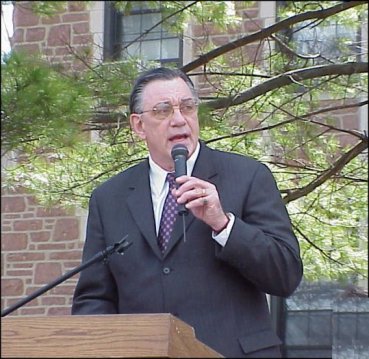
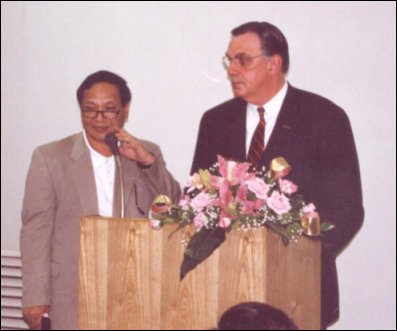
(Editor Note: This is the speech Dr. Golden made at THE INTERNATIONAL FORUM FOR UNIVERSITY PRESIDENTS ON THE CHALLENGE OF THE E-ERA FOR HIGHER EDUCATION: "GLOBALIZATION, MULTICULTURALISM, AND MODERN TECHNOLOGY" on March 22, 2002 at Ming Chuan University, Taoyuan Campus, Taipei, Taiwan)
At the beginning of the current academic year, many college and university presidents in the United States of America were trying to resolve the Ten Public Policy Issues for Higher Education as specified by the Association of Governing Boards for 2001-02. The issues cited were (1) tax cuts and the federal budget, (2) economic slow down, (3) affirmative action, (4) student aid policies, (5) economic and workforce development, (6) information technology, (7) teacher training and quality, (8) public perception of higher education, (9) standards, accountability, and high- stakes testing and (10) intercollegiate athletics.1 Other subjects occupying the time and energy of the college and university CEO's included, but were not limited to, the following: (a) Case Study: How Commitment to Technology Advanced our Strategic Plan,2 (b) Higher Education: On a Collision Course with New Realities,3 (c) Tuition Rises Faster Than Ability to Pay4 and (d) Reducing Student Costs and Enhancing Student Learning: The University Challenge of the 1990's.5
The overall picture was that college and university presidents were earnestly striving to address and resolve many pressing issues. Essentially stated, they wanted to deliver the best possible product (excellent educational programs) to the students (customers/consumers) in the most effective, efficient and ethical ways possible. And as everyone in this audience very well knows, the student population in the USA is comprised not only of Americans but also of multiple thousands of excellent international students.
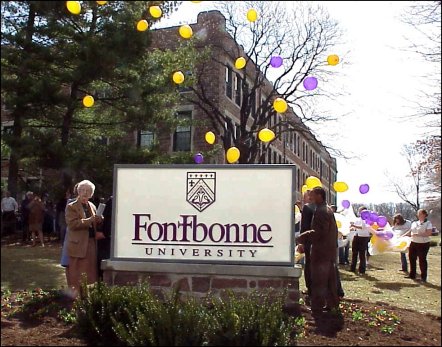
For instance, in the overall picture at Fontbonne University, we have educated students from Thailand, Spain, England, Republic of China, Ireland, Canada, Saudi Arabia, El Salvador, Peoples Republic of China, Brazil, Japan, Korea and many other countries. This is quite an achievement for a modest-sized, student-centered, values-based, co-educational, Catholic university sponsored by the Sisters of St. Joseph of Carondelet. Our size notwithstanding, we offer excellent liberal arts, masters and professional programs to our 2,190 students, and we are committed to the positive results that flow from international education. That overall picture changed dramatically on the morning of September 11, 2001. Just twenty-four hours earlier, I had given a professional workshop at the University of Wisconsin- Stevens Point, which is about an eight-hour car ride north of St. Louis, Missouri. After completing the workshop on September 10, I drove south to the University of Wisconsin in Madison in order to see two professional colleagues prior to returning to St. Louis. On the morning of September 11, I awoke, freshened up, read the local newspaper and took the elevator to the hotel lobby to have breakfast. As the elevator door opened, I saw people fixated on the TV set, and I immediately watched a jet plane crash into one of the twin towers in New York City. For a split second, I thought this might be a Hollywood movie but only for a split second. Immediately thereafter, I was overcome with that same sense of tactical and military instinct that I had acquired as a Captain in the United States Marine Corps. I realized that this was serious. I realized that the devastating destruction could have a demonic as well as a terroristic genesis. I realized that because it was the World Trade Center that this would have world-wide not just American ramifications. I realized that America had been pushed over the edge and had now joined the rest of the world insofar as the terror in NYC, the Pentagon and Pennsylvania was concerned. It was clear that things as we knew them would never be the same and that the focus needed to be more on people and less on product.
Since the tragic events of September 11, there has been much discussion of how our work in higher education will be affected. Indeed, Jay Morley the President of the National Association of College and University Business Officers (USA) stated, and I quote: "The next battle against tyranny and constraint of freedom is not primarily a war in which those with the most technology and industrial production win - it is a contest of political and economic freedom against the tyranny of a few."6
(part 1 of 3, to be continued next
week...)
1. Ingram, Richard T., President, Association of Governing Boards of Universities and Colleges, Public Policy Paper No. 01-1. Washington, DC, June 2001.
2. Detweiler, Richard A,. President, Hartwick College. Case Study: How a Commitment to Technology Advanced our Strategic Plan. AGB Occasional Paper No 32. Washington, DC. 1997.
3. Breneman, David W. Higher Education: On a Collision Course with New Realities. AGB Occasional Paper No. 22. Washington DC, 1993.
4. Dunn, John A. Jr. Tuition Rises Faster Than Ability to Pay. AGB Occasional Paper No. 17, Washington, DC, 1991.
5. Gustin, Alan E. Reducing Student Costs and Enhancing Student Learning: The University Challenge of the1990's. AGB Occasional Paper No. 27, Washington, DC, 1994.
6. Manly, Jay. Responding To Terrorism., NACUBO Business Officer, NACUBO Magazine. Washington, DC. p.11.
|