AMB. DANIEL LEW AT PRINCIPIA COLLEGE: Small Steps, Significant Strides
By Dr. J. Bryan Collester
The unity of Mainland China and Taiwan will come about, but not through force or military means. It will come about through a transformation spiritually and morally. And that transformation will come about "through interchange with the United States," which has befriended China and provided a beacon of liberty and human freedom for many decades, said Ambassador Daniel Lew. Taiwan, too, he said, has a significant role as a model for China's economic progress and democratic development.
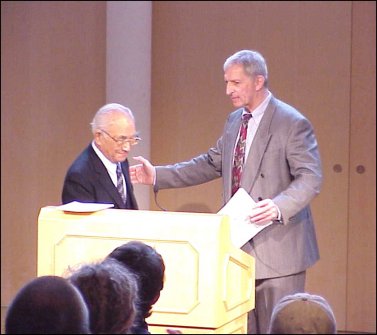
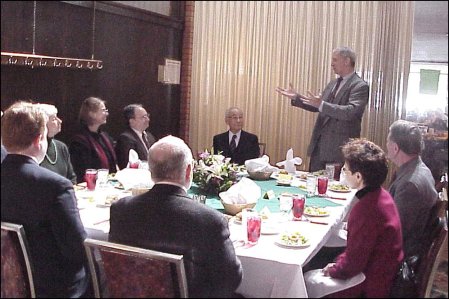
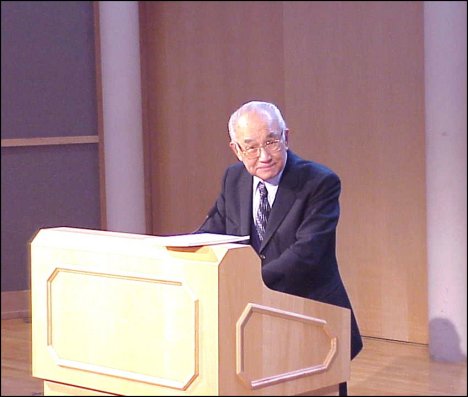
Speaking to a lettered audience of students, faculty and distinguished guests at Principia College in Elsah, IL, on Monday, March 4, Yu-tang Daniel Lew, who witnessed much of the history about which he spoke, was Nationalist (Republic of) China's last ambassador to the United Nations.
Without notes, the nimble, octogenarian diplomat began with a story of Anselm Burlingame, whom President Abraham Lincoln had sent to Beijing as U.S. minister. So successful was Burlingame that at the end of his 6-year service, the government of China asked Burlingame to represent them officially to Western and European capitals. He died while in Russia representing China. As an American, Burlingame had given his life in service of China, Lew asserted. And, continued Lew, this true story is symbolic of the long history of relations between the United States and China, a relation of friendship, of trust and of good will.
At the end of the 19th and beginning of the 20th centuries, the United States again came to China's aid in a still more vital way, said Lew. U.S. Secretary of State John Hay, previously Lincoln's personal secretary, enunciated the "Open Door" policy, which perforated the concession-system and arrested the literal dismemberment of China. That support characterizes the spirit of American diplomacy towards China.
Sun Yat-sen, sometimes called the "George Washington" (father) of China's republican revolution in 1911, was in Denver, Colorado, when he heard of the revolution's outbreak on October 10, (genesis of the10/10 day of celebration), Lew told his audience. When asked if he had raised much money on the trip, Sun replied: "Not a lot, but I have the friendship of America."
Generalissimo Jiang Kai-shek, who succeeded Dr. Sun as leader of the Nationalist Party (KMT) also come to know America well, first through his wife, Soong Mei-ling, sister-in-law to Dr. Sun. Soong Mei-ling, whose family lived in the United States, was graduated from Wellesley College. After marrying Jiang, Madame Jiang, as she became known, served the KMT in many capacities and is still living in New York City at the ripe old age of 105.
Lew argued that Jiang and the KMT continued to fight the Japanese almost single-handedly, despite the united front agreement between the KMT and the CCP's "Eighth Route Army." And he praised Jiang's dedication to China again, when he said Jiang decided to remove to Taiwan in 1949 pursued hotly by Mao's Red Army, rather than to the wartime capital and safety of Chongqing. Lew noted that if Jiang had gone to Chongqing rather than to Taiwan, Taiwan today would be like Tibet, a colonized, captive, Semi-Autonomous Republic of the PRC.
Jumping forward to 1971, when Taiwan (Republic of China) was expelled from the United Nations and replaced by the PRC, Lew, the ROC ambassador at the time, stated that the UN General Assembly had rejected Taiwan by a 2/3 vote, He questioned the legal status of the PRC's seating, however, since, as Lew said, the UN still has the name of the ROC in its Charter (and General Assembly Resolution 2758 unseating Taiwan did not change that!)
And how should America effect its historic role to transform China spiritually and morally? For example, said
Ambassador Lew, President George W. Bush's unvarnished talk about democracy and human rights to the students at prestigious Tsinghua University in Beijing on February 22 is the kind of incremental step needed to help "loosen up" China. And Lew left little doubt that U.S. military arms sales to Taiwan or support for independence would ultimately solve the problem of the Taiwan Strait. President Bush, who noted that Tsinghua University had been founded "with the support of my country," was received "exultantly" by the Tsinghua students and without confrontation.
Lew also left no doubt that while such efforts by the United States may seem small, out of scale with the challenge, they are not! Rather, such initiatives, and patience, are the beacons, which will grow into a new dawn and brighter day in U.S./China relations. And Taiwan? It is the off-shore model for democracy and enlightened Chinese policy, as Lew's favorite American president proclaimed at Gettysburg in 1863: "that government of the people, by the people, and for the people..."
As a post-script, it is worth noting that another great Chinese-American scholar Tu Wei-ming, Professor of Chinese History and Philosophy and director of the Yenching Institute of Harvard University, spoke eloquently at a University of Missouri, St. Louis symposium last February 9, sponsored by Dr. Joel Glassman, director of UMSL's Center for International Studies (and distinguished guest at the Lew lecture). Professor Tu also noted how important the United States is to China and contended that China closely watches what the United States does and says, even when appearing not to. In short, Tu asserted, the United States has a vitally important role to play in China's reconciliation to its world role, and that we should not become impatient, or truculent, and most of all not bellicose. It was a message Lew reiterated at Principia. But that's really not so strange; Daniel Lew first met Tu Wei-Ming as a student at Harvard 40 years ago. It's a small world - with big ideas! |