By Frank Lutz
For St. Louis Chinese American, St. Louis
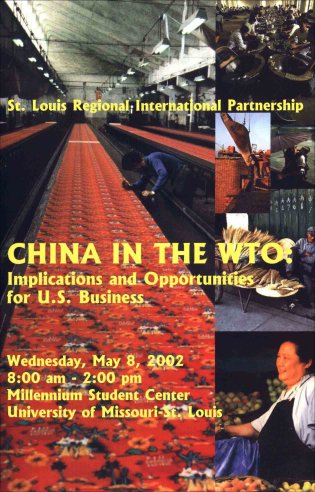
There is a Chinese saying: "There is no failure, only the opportunity to learn." This was the basis of a fine seminar put on at the University of Missouri St. Louis (UMSL). Entitled China in the WTO: Implications and Opportunities, the Seminar talked about the growing market of China, China's economic and cultural climate.
The seminar took place May 8th, 2002, in the UMSL campus new Millennium Student Center. From the ambitious students to weathered corporate staff members, a great diversity of people attending. Dr. Joel Glassman, Director of the Center of International Studies (UMSL) announced the itinerary and then the first speaker, Ms. Karen Sutter, Director of Business Advisory Services (U.S. - China Business Council, Washington D.C.). Ms. Sutter spoke frankly and to the point. She spoke of pertinent issues facing American businesses in the post WTO China.
Positive mentions of how the Chinese government is advocating various economic stimulus programs; how utilized investments are up; how the service sector is growing were all gratifying to hear among the business audience. All these bits of good news were balanced with an equal amount of cautionary information from Ms. Sutter as well.
"The fact that many levels of the Chinese Communist Party will soon be experiencing change-overs is a real issue to the business community.", she said. From Jiang Zemin all the way down to local magistrates, there will be political officer changes effecting business in various ways. While Ms. Sutter presented this information as 'cautionary', she encouraged everyone to be optimistic.
Her continued optimism came through in the statement that the non-state run businesses are responsible for most of the outstanding economic growth in China. Also, imports to China had increased significantly. The fact that various tariffs are scheduled to be lowered per the WTO agreements also bolstered her optimism.
Ms. Sutter ended her talk with one last cautionary bit of information for the American businessmen. She acknowledged that European Union nations have a great head start in the Chinese market. "The Europeans haven't been waiting for the WTO.", she said. "They've been there much longer than us and have established the relationships necessary for good partners." And with this acknowledgment she thanked everyone for their interest.
Followed by Ms. Sutter speech was a various breakout sessions. The Marketing/Distribution session was moderated by Mr. Larry Taylor form Aziotics. Mr. Taylor presented Mr. Mike Barron, a Principle at Barron and Associates. Mr. Barron spoke specifically about two cities; Shen Yang and Cheng Du. He saw these as the two greatest industrial-friendly cities in China. Though he spoke very highly of the actual factories and technology employed in these cities, he quickly pointed out that all this 'business friendly hardware' is nothing if one doesn't have 'quanxi', or relationships, in China.
'Quanxi' was mentioned time and time again, not only by Mr. Barron, but also by most of the speakers in the various sessions throughout the day. Mr. Barron, in his very blunt manner, made everyone aware that without 'quanxi', no business plan or any amount of investment will bear fruit. Trust is paramount. He urged the American businessmen to establish relationships with representatives, agents, and officials. Make allowances for the English/Chinese language translations was another cautionary piece of advice.
He noted also that the Chinese businessmen would ask the same question time and time again to a point of irritation. Mr. Barron's opinion of this practice was to cross check all the facts being presented by the westerners.
"The Chinese businessmen love banquets." declared Mr. Brown. "If you drink, be prepared to drink a lot.", he said. Later, Mr. Paul Johanson, co -founder of Sixus, would clarify that "If you don't want to drink, you should establish this up front and never deviate from your non-drinking status. If you take one drink, you are socially compelled to take part in the drinking."
The last point Mr. Barron made was how well the Chinese businessmen do their homework. They check, and re-check, everything about every aspect of your business and the markets.
In closing, Mr. Barron iterated the '3 Ps'. Patience, Patience, Patience. The Chinese are thorough and in for the long term.", he noted. Be prepared to take the time to follow the negotiations through as well.
The presentation of Mr. Ernie Stokes, International Sales Manager of Western Lithotech, was the most straightforward. However, his demeanor seemed somewhat defensive. One got a sense that, unlike the previous speakers, he had experienced more bad in China than good.
While all his information was valid and obviously learned from experience, it all focused on defensiveness in the market. It was clear he had experienced many a difficult negotiation. He spoke of traps and guises in China. However, all his warnings of frustrating approval processes, 'friendship traps', 'baiting', and deceptions don't seem like anything different than what can be encountered even here in the U.S. Business is business, regardless of where in the world you are. The same basic rules apply.
Once Mr. Stokes' presentation had ended there came a short break before the breakout session entitled Cultural Communication Challenges.
Moderator Dr. John Zhao of Saint Louis University presented Ms. Linda Jacobsen, President of Global Vision Strategies. Ms. Jacobsen gave a compelling and enlightening presentation beginning with a picture of a mountainside. She described a snow-capped mountain and a man at the top of the mountain who had devised a way to channel the melt-off water to the rice terraces below in an efficient and effective way. Ms. Jacobsen then described the subsequent farmers on the cascading terraces below and how the lines of communication, as well as the flow of water between the farmers at the bottom traveled from farmer to farmer until word, and water, would circulate fully.
Ms. Jacobsen described how everyone might not have direct contact with one another, but everyone affected each other and was aware of the other's condition. She then described an American coming to the mountainside; how he placed himself in the middle of this delicate network of farmers and how his ignorance of culture and protocol affected the harmony of the network. The American's lack of tact and awareness of protocol adversely affected the all farmers. This put the farmers in a defensive position. From this example Ms. Jacobsen gleaned the Chinese saying: "Know where your water comes from."
After Ms. Jacobsen came Dr. Jacky Yuk-Chow So from the Academy of Entrepreneurial Finance at Southern Illinois University. While Dr. So's proficiency is Finance, he expanded on Ms. Jacobson's picture of the hillside scenario, but with a different scenario.
He took her mountain and explained how a man wanted to take his goods to the town on the other side of the mountain. However, the mountain was too high and treacherous to travel over. So, the man began to pick away at the mountain. Another hypothetical American came along and asked why he was trying to move this mountain. The Chinese man explained by moving the mountain it would make the journey to the town on the other side easier. The American exclaimed that the man couldn't move this mountain in his lifetime. To this, the Chinese man explained, 'If I don't get this done in my life, my son will continue the effort. If he doesn't finish in his lifetime, his son will continue the effort. And so on until the mountain is moved for our descendants.'
Dr. So's point being that the Chinese mentality has always been in the long term. He described U.S. companies who had business plans for 18 months while some Chinese institutions have 1000-year plans. While both are extremes, it serves to illustrate the differences in objectives between U.S. and Chinese companies. The point was well taken.
Dr. So continued to illustrate various differences to be aware of in China. Differences such as:
American Attitude: Individualism, Informality, Competition, Outspoken
Chinese Attitude: Collectivism, Formality, Cooperation, Quiet; reserved
In conclusion, Dr. So reinforced the Chinese principle concerns in everyday life: Family, Friends, and Face. These principles are of the highest regard, even when considering business dealings.
This ended the breakout sessions for the seminar.
At this time, the attendees gathered for the 2002 St. Louis Global Excellence Award presentation. The award was presented to J.D Streett and Company, Inc., a small auto lubricant and antifreeze manufacturer in Maryland Heights, Missouri.
J.D. Streett has been in business since 1884. They began by making the grease for the wheels of wagon trains headed west from St. Louis. Since then, they've provided product to iron ore mines, mills and railroads. They've serviced automotive needs since they were first invented. J.D. Street began exporting their quality U.S. made lubricants just four years ago. In this time they've shipped their product to virtually every corner of the world.
UMSL and the sponsors of this seminar are to be commended for an excellent presentation.
About the author:

Frank Lutz is an independent freelancer who is moving from St. Louis to Beijing, China early June. Frank will be attending the Beijing Language and Culture University studying Mandarin and other Chinese cultural aspects. Frank's freelance business has been Graphic Design with an emphasis on Web Development disciplines (www.zdezign.com). Frank was born and raised in Europe. He has lived in Italy, Portugal, and Germany.
Frank will be corresponding with the St. Louis Chinese American News in an ongoing column about the processes involved with traveling and living in Beijing as an American.
|