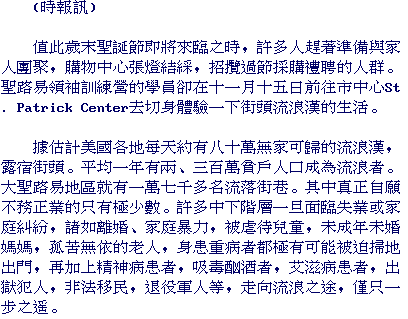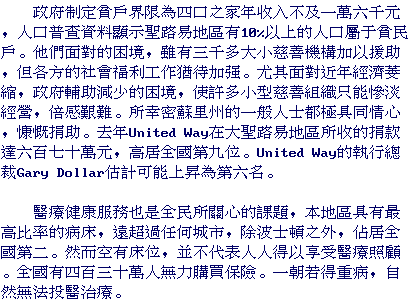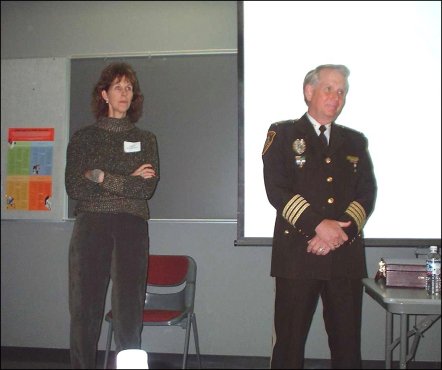
FOCUS executive director Chris Chadwick with Chief Ronald Battelle of St. Louis County Police Department.
By
Scanews staff
Thanksgiving and Christmas are around the corner. Salvation Army's X'mas tree is lit. People plan to go home for a family reunion with many gifts in their hands. We, the fortunate ones, tend to forget there are
estimated 800,000 homeless people on the street every night nationwide, and about 2.5 to 3.5 million people a year experience homelessness, 17,000 in St. Louis area. Participants of the Leadership St. Louis 2002-2003 sat among many homeless for lunch on Friday, November 15, 2002. This is a day hard to forget for many of us. St. Patrick Center downtown serve meals to more than four hundred people daily. As McGraw Milhaven, KMOX radio talk show host, said with tears in his eyes, "It made me to think how fortunate I am, and what can we do to help."
This Friday morning started with site visits to one of the eight social service agencies providing services to newborn babies, teenage mothers, abused children, AIDS patients and children with HIV positive, child care center and one legal service agency. According to the United Way of Greater St. Louis, there are over 3,000 agencies in this area and serve 8400 Sq. miles providing some kind of programs to help the needy. The U. S. Census Bureau set the poverty threshold for the average family of four at $16,029 in 1997. Poverty statistics show over 10% of St. Louis population live below the official poverty line. With recent
influx of immigrants, it also found that racial minorities in the region generally experience a
disproportionately high rate of poverty.
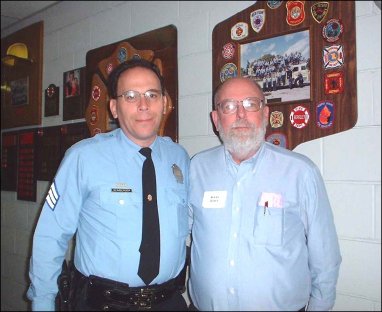
Program director, Prof. Terry Jones with Sgt. Bob Heimberger
of St. Louis Metropolitan Police Department
Voluntary homelessness is just a tiny percent of larger problems. Ordinary people might be only a pay check away from becoming homeless. Many working poor faced with family problems, such as divorce, domestic violence, child abuse, battered wives, pregnant teenagers, elders, serious sickness, loss of jobs, etc. are possible to be thrown out of home and forced to live in the street. In addition, there are people with mental illness, chemical dependency, AIDS patients, released prisoners, illegal immigrants, children exit from foster care, veterans, and many others are potential candidates of homelessness. Many human service organizations work with collaborative effects to face the challenges in helping people and to ensure the basic needs of all individuals are met.
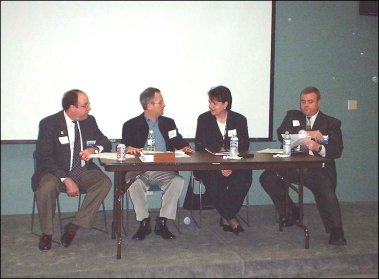
(From left to right) Peter Sortino, Chairman of St. Louis Regional
Health Commission, with his team members, Robert Massie, Joan Bialczak and
Scott Steiner
Leadership afternoon program gave
participants a chance to gain an overview of the health care system in St. Louis. Gary Dollar, President and CEO of United Way of Greater St. Louis, praised the state of Missouri for being very generous. Last year's donation amounted to 67.5 million and ranked the 9th in the nation. With this year's economic difficulties, United Way of Greater St. Louis may receive the 6th largest donations nationally. However, local service agencies face dramatic changes in federal welfare policies with long-term decreases in government funding, plus an emerging trend toward service consolidation have created an uncertain future for many of these services.
St. Louis is rich with health care resources, with the Missouri Foundation for Health being one of the top 50 foundations in the United States, and more hospital beds per capita than any other place except Boston. The accessibility to the health service, however, is very poor with the major reason of being lack of health insurance, in addition to geographic and cultural barriers. It is estimated that 43 million of the population are without health care annually due to financial difficulties. The St. Louis Regional Health Commission (RHC) is an example of collaboration between various organizations and
individuals to improving health in the St. Louis area. The RHC is comprised of community members, health care providers, and government leaders from St. Louis City, St. Louis County, and the State of Missouri.
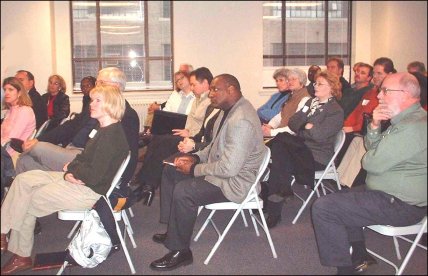
Leadership
Training in Session
Many participants of the Leadership program were offered the chance to visit the Thomas F. Eagleton Federal Court Building and to ride along with police as a prelude to gain some insights to the criminal justice system. At the Family Court of St. Louis County, we met the dynamic Judge Susan Block and learned about the Court Appointed Special Advocates (CASA) and the Mentor Program. The CASA was created in 1977 to make sure that abused and neglected children would not be abused and neglected at the hands of the social service system.
Every year about 3 million of children suffer from some form of abuse or neglect resulting in over 4,000 deaths. Yet only 3 % serious cases are reported to the authorities. When these youngsters get to the courtroom, they are not necessarily represented with their best interest in mind. the CASA volunteers are thoroughly trained in
courtroom procedure, social services, the juvenile justice system, and the special needs of abused and neglected children. They are a powerful voice in a child's life. The Mentor Program recruits people who are committed to real solutions for kids.
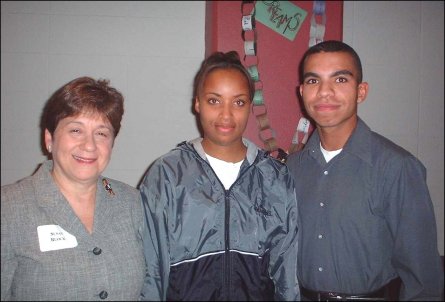
Judge Susan Block with Nykiah &
Michael
We met Nykiah and Michael who are the successful outcome of these programs. Nykiah was an abused child and came to the support system at the age of eleven. She is now 20 and just bought an apartment, working, and attending the St. Louis Community College. She related her story emotionally about a social worker who would resign from her job in order to adopt Nykiah because of her breech of conflict of interest.
Michael is expecting to graduate from the Police Academy next month. He
was a neglected child with family members involved in drug
trafficking. These two shining examples tucked at our emotions and many felt the benefits that programs like CASA can do. Otherwise, troubled youngsters have no family to call their own, more likely than others to face homelessness, unemployment, and even prison as adults. Anyone interested to lend a helping hand, please contact (314) 615-2908 or (314) 615-4400 for more information.

St. Louis County Prosecuting Attorney Bob McCulloch
and Dr. Chingling Tai
The program was
concluded with an overview into the law enforcement system,
including the roles of police, prosecutor, judge and jury. Prosecuting Attorney Bob McCulloch and Col. Ronald Battelle, Chief of Police, represent St. Louis County together with Jennifer Joyce, Circuit Attorney and Chief Joe Mokwa both from the City of St. Louis, answered challenging questions put forth by the Leadership class with judges, lawyers and state policy makers among them.
The vicious circle routes from committing crime out of poverty, to being arrested and prosecuted, to a decision for sentencing and parole is affected by many individuals whose discretionary decision may lead to different outcomes. The state spends around $20,000 a year to keep a prisoner. Ironically, the figure is higher than the official poverty line set for a family of four! Human dignity and safety remain to be a perennial concern for our society.

What can we help? For a start, McGraw Milhaven announced that the day after Thanksgiving, Friday November 29th he will host his show on the site of 9505 Gravois, the National Headquarters for Nurses for Newborns. It's going to be a two hour radio-a-thon from 9-11 am. aired from 1120 KMOX. (That's AM, not FM, Norm). McDonalds has agreed to put a collection jug in each store throughout the St Louis Metro area for the day. People can stop by any McDonalds to give money. In fact, Hoffman-Lewis, the ad agency, has agreed to cover all costs of the fundraiser so 100% of the money can be given to Nurses. Let's join hands for a good course and a better future.
|