Issue:
645 Date: 01/01/2003 
Celebrate Chinese Americans great contributions
A series of articles that dedicate to describing the accomplishments made by Chinese Americans to the United States
|
|
By Wubing Zong
Chinese American Forum
Ever since three Chinese seamen landed at Baltimore, MD. in 1785, Chinese
Americans in the United States have had to struggle against prejudice and
discrimination (e.g. Chinese Exclusion Lawst, 1882-1888) just to survive
in the American mainstream. Although Chinese Exclusion Laws were repealed in 1943, prejudice and discrimination still arise when it is politically expedient. For the past 200 years, relying on hard work and self-discipline, Chinese Americans have made great contributions to the development and prosperity of the United States. This series of articles is dedicated to describing many of the accomplishments made by Chinese Americans.
This series of articles are edited by Ms. Wubing Zong.
Wubing Zong was an editor at Xuelint Publishing House in Shanghai, China. She has her B.A. in History from
Shanghai Teacher's University and her M.A. in Western Historiography from Eastern China Normal
University in Shanghai. Currently she resides with her husband Tony Gao and
daughter Cindy in Chesterfield, MO. She divides her time among working
at her husband's law firm, her family, and volunteer work for the
Chinese
American Forum, and other things.
|
Chinese American Artists - Maya Lin

Born: Oct. 5, 1959
Place of birth:
Athens, Ohio
Profession: Architect
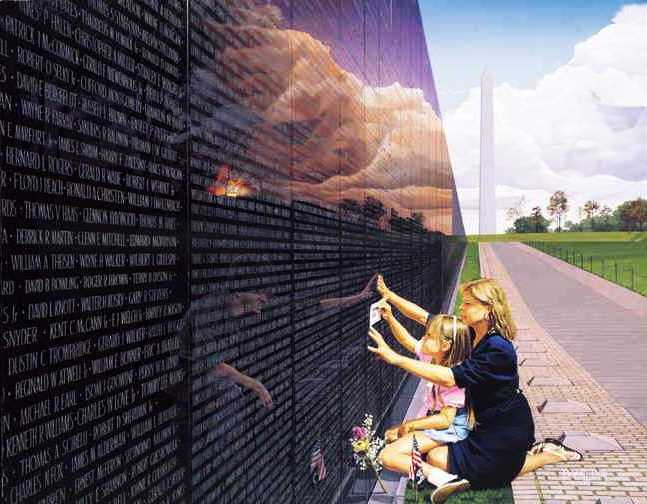
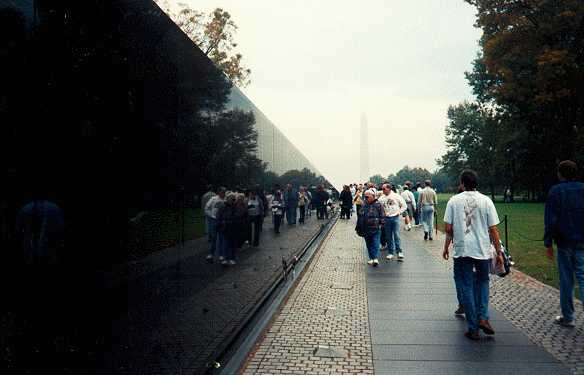
Maya Lin designed the most visited public American artwork of the 20th century, the National Vietnam Veterans Memorial.
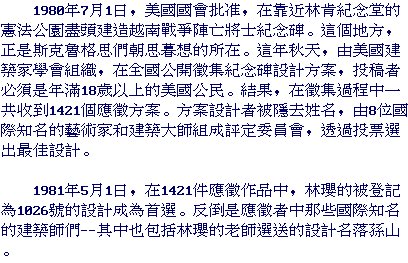
In the fall of 1980, the Vietnam Veterans' memorial Fund, established by Ian Scruggs and other veterans who had collected seven million dollars,
announced a competition to create a monument to the US soldiers who fought
in Vietnam, to be installed in Constitution Gardens in Washington, D.C.
The requirements were that the artwork be by an adult American citizen, be
contemplative and harmonious with its site, make no political statement,
and contain the names of all military personnel who had died.
There were 1,421 entries responded to the competition. Maya Lin, then 21
years old, a Yale student majoring Architecture, won first place with her
entry.
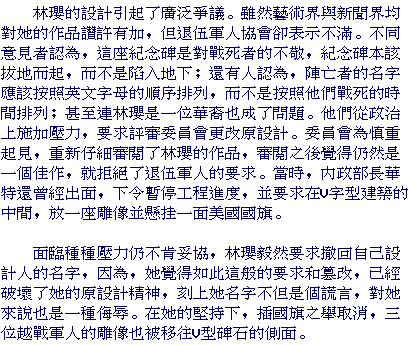
The project was controversial from the beginning. Maya Lin was forced more than once to defend her design and her personal background at the public
hearings in Washington. In the process, Maya Lin showed the strength of
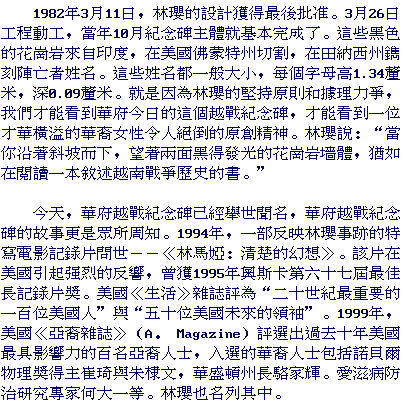
her character. The power of the design prevails: the "Vietnam memorial
wall" was dedicated on November 13, 1982. Ultimately, Lin's work was well
received by the millions who have visited the wall and are deeply moved by
it.
After the Memorial was built, Lin continued her architectural design career. In 1989, the Civil Rights Memorial in
Montgomery, Alabama was dedicated. She also designed the "Women's Table," an outdoor sculpture at
Yale University. Among the other projects that she worked on are the Open
Air Chapel at Juanita College in Huntington, Pennsylvania (1989), the Rosa
Esman Gallery in New York (1990), and TOPO Topiary Playing Field in
Charlotte, North Carolina (1991, with Henry Arnold), and a clock for the
ren-ovated Pennsylvania Street Station in New York (1994).
Maya Lin has won many awards and honors. She has received an honorary doctorate of fine art's degree from Yale University (1987), the
Presidential Design Award (1988), and the American Institute of Architects
Honor Awards (1984). Her work has also been shown in many exhibitions.
|


