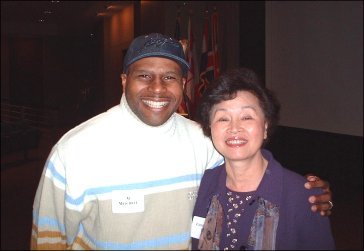
Author Al Mitchell & 2003 Leadership classmate Chingling Tai
By Albert Mitchell
- Director of Finance, Animal Agriculture Business, Monsanto Company
There are many critical issues impacting the St. Louis region that must be addressed before it can truly be seen as a top tier city. To date, the 2002-2003 Leadership St. Louis Class has spent the past few months looking at regional economics, the criminal justice system, and poverty. However, most people acknowledge that the divide between the black and white races is probably the number one issue impacting the St. Louis area, and the nation as a whole. If there is any doubt of this assertion, or the seriousness of this issue, one need only look at some of the events that have transpired since the class met in early December, including: 1.) Senate Republican Leader Trent Lott
ill-fated comments praising the racial divide and segregation of the past, 2.) the Jefferson County
school teacher who shared her disdain for interracial relationships with her 8th grade class, and 3.) the Jennings School District teacher who was reprimanded for sharing racial jokes and poems with her 7th grade class, in order to explore a racial epithet. For many African Americans, these events are not surprising or even shocking, as we have become conditioned to expect, and live, with racial prejudice in many forms, and on many levels. To many in the white community, however, these are not as meaningful because they see no direct impact to their daily lives. The FOCUS organization expressed a similar view in its report titled Racial Equality in the St. Louis Region: A Community Call to Action, which said, For many whites, the issue often seems remote and overblown. Yet, there are others who simply refuse to acknowledge the problem due to a conscious, or subconscious, thought of having to relinquish their access to power.
Realizing the criticality of this issue in building leadership within the region, the 2002-2003 Leadership St. Louis Class spent December 6-7, exploring the topic of racism from a historic, individual, organizational, and civic level, on the campuses of Monsanto and Edward Jones. The primary objectives for the 2 days were to bring awareness to the lack of racial harmony in the region, provide some context and understanding on elements that perpetuate this divisive climate, and to develop skills that would allow for positive contribution in bridging the gap between the races. To accomplish this, the program consisted of a series of presentations, open dialogue, and group exercises designed to increase our ability to recognize the existence of prejudice, discrimination, stereotyping, and racism in ourselves, while teaching how history, institutional policies, cultural stereotypes, and norms all interact to maintain racial hierarchies and inequities.
The subject of racism in America is not new. It is a fact about our society that has impacted all of our lives, and if not addressed will impact our children's lives. Although we have made some positive strides in addressing racial issues, we still have a long way to go. A recent report indicated that St. Louis is the 4th most segregated city in the United States. Talking about racism is difficult, uncomfortable, and can be personally risky for members of both races. It takes courage and conviction in order to have open and honest dialogue on this subject. However, simply talking about racism and its implications/effects can become just that talk that makes you feel like you are doing something when you are not. We must understand and accept that racism is not just this year's or this decade's problem, and is not an issue that impacts the African American community only. The ability to attract large businesses and the best talent to the area are directly influenced by how the region is perceived, and the effects of racism play a large part in this. For evidence of this, one only needs to look at our own families. Many of the young from the Bi-state region are getting their education elsewhere and not returning. And, until we address this with a collaborative effort between the races to shift people's attitudes and behaviors, and get beyond just talking about it, we will not see the change that is needed in order for the St. Louis to be mentioned in the same circles with Atlanta, Chicago, and other more progressive cities.
So how do we do this, and where do we begin? As Ron Jackson, one the facilitators for the program, stated, 'the first step in resolving the problem is to first acknowledge that there is a problem'. It is evident from numerous surveys on race relations, and the FOCUS report mentioned above, that the black and white races differ on the severity of racism impacting the region. So, if we are going to make progress in understanding and addressing the symptoms of racism, we must bridge this gap that exists in order to mobilize the races along a common objective. One of the things that create this difference in opinions is the lack of knowledge or understanding by the white community of racial prejudice because they are not subjected to it. This is a privilege afforded them, which many are blind to. As we discovered during our 2 day session,
Privilege, recognized or not, is a social and economic benefit, and all people have prejudices, but not all people can enforce their attitudes through institutions and systems of power.
On the surface these 2 statements may not seem like much, but it is important that we understand and acknowledge that this is factual, as it relates to being white or black in America. It is the basis on which many of the civil right issues are grounded, and why it clearly is not a level playing field for the non-majority.
This concept was further expanded on as facilitators Dan Bradley and Rob Good led a discussion of what was termed the 'Fabric of Social Power' in the U.S., and how the line of access to social power (or privileges) is granted based on the many things that make you up. Examples of this include, but not limited to, race, gender, class, religion, and sexual orientation. However, of all the characteristics that make up an individual, the one that is most evident, even before an individual utters a single word, is skin color. And throughout history in our society, skin color, or race, has been used to define the privileges and access to
social power that is granted. And the group that is impacted most by this is the African American population. This is a reality that few individuals of the majority or white race truly understand, and some do not want to understand. It requires the willingness to question the values that many believe in, that hard work will get you a piece of the American dream. Really talking about it is especially uncomfortable for whites, who, rarely have to consider how being a member of the dominant group affects them and others. Quite simply, most white Americans don't think about being white, don't reflect on (or admit) how being white benefits them, and don't acknowledge the existence of a white culture. As an example, many do not understand, that being white ...means expensive cars, clothing, and jewelry are symbols of wealth and influence, not criminal activity,
---means being sure that any store selling hair and facial products, will carry products designed to meet their needs,
---means driving across country, visiting small towns and out of the way places, without worrying about being harassed or refused service,
---means never having anyone question whether your acceptance into a college/university is earned
---means never having anyone question whether you were hired or promoted based on your merits alone.
One of the major privileges of membership in the majority is not 'seeing' the benefits or privileges afforded you, because it is so much a part of reality and ways the world is and that its members take it for granted, like breathing. An exercise that we performed outdoors on the Monsanto campus, visually demonstrated some of the privileges of being white that are passed on through generations, including educational and employment opportunities, and how this provides an advantage to those in the dominant race, while leaving those not identified within the majority to work harder in order to compete. The first day concluded with the group breaking into smaller groups, which allowed members of the African American community to share their real life experiences of racism with their colleagues, to further bring awareness to the lack of access and prejudicial treatment we have received, merely due to the color of our skin.
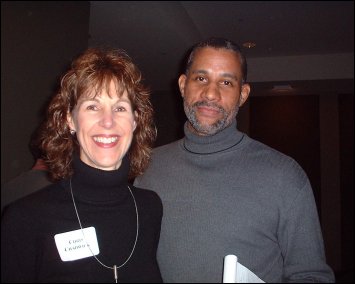
St. Louis Aspen roundtable leaders- Khatib Waheed & Chris Chadwick
Once the white community understands the advantages and disadvantages attached to skin color, will they begin to understand how this has permeated into our policies and practices. On Saturday, we began to explore the things that play a role in maintaining racial hierarchies and inequities. We listened to a fascinating presentation given by Stacey Sutton, Research Associate, Aspen Institute on Structural Racism and Community Building, were she presented the work the institute has done to better understand the impact structural racism has had on the disparities we see among the races regarding poverty, income, home ownership, access to credit, education, and criminal justice system. Structural racism refers to the ways in which history, public policies, institutional practices, cultural stereotypes and norms interact to maintain racial hierarchies and inequitable racial group outcomes. Their work suggests that many "non-white" groups have been subordinated by institutional and cultural norms predicated on white supremacy or the dominant culture. She further explained how a lack of understanding and acceptance of structural racism has resulted in some of the racialized national values that exist today among the white community, such as personal responsibility (everyone controls their fate), meritocracy (resources and opportunities are distributed according to talent and effort), and equal opportunity (the playing field is level). It is the belief in these national values that help to maintain the inequities that exist, and masks the racism (overt and discreet) that exists in our policies, processes, and institutions. As previously mentioned, it is the belief in these values that prevents some within the white community to not acknowledge the existence of racism on a large scale, if at all.
Neither of the topics addressed above are new perspectives on addressing the racism issue. Since the 1970s, an organization called the Society for Intercultural Education, Training and Research (SIETAR) has researched and identified 14 key skills for successfully working with diverse groups. The number one skill they identified is to be aware of your own culture by 1.) acknowledging your personal norms and assumptions while not expecting all others to have the same values, and 2.) being aware that your behavior is driven by your basic cultural values and beliefs. The second skill they identified is to be aware of your own limitations by being conscious of how your perceptions are formed, since these preconceived biases and assumptions create personal limitations. Both of these skills are crucial to advancing toward solutions to fixing the racial divide in our region. The discussions and exercises that we engaged in during our leadership session were important in developing these skills of the leaders in the class. If nothing else, I hope members of the class remember the exercise we performed on the Monsanto campus, and take away one thing if nothing else as Susan Buford alluded to, not all African Americans come up in the same environment, but all will be subjected to the same practices and policies merely due to the color of our skin.
For many, the two days were very moving and opened their eyes to some of the inequities and hardships that many African Americans must endure just to get the same opportunities as whites. This, by no means, is meant to absolve the African American community of the problems and issues that we acknowledge exist and are in our control. But if we are going to have a more collaborative effort to address this issue and come up with solutions, the white community must be engaged as passionately as many in the black community. Hopefully, those who failed to get anything out of the day, or who found themselves thinking of exceptions to the privileges that were discussed, will take some time to reflect on why it is natural for them to search for exceptions and not acknowledge that, which is true. Talking and thinking about the dominant culture's impact on our society, and its impact on the behaviors of others, is the first step toward understanding the differences in people and the racial divide. My mother once told me that in order to move forward and make progress on anything, you must understand were you've been, or you are doomed to repeat the past. It is not a coincidence that we are in the year 2003 and we're still discussing race relations between blacks and whites, and the huge disparities that exist. If we are going to make headway as the best leadership class ever, we must not only continue the dialogue we have begun, but we must actively pursue the change we want to see.
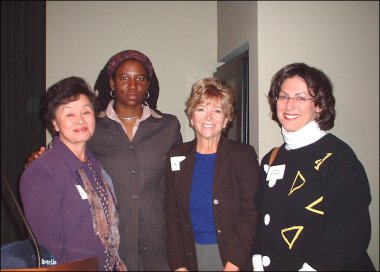
(from left) Chingling Tai, Stacey Sutton (Aspen Research Associate)
Susan Wedemeyer & Susan Weissman
|