|
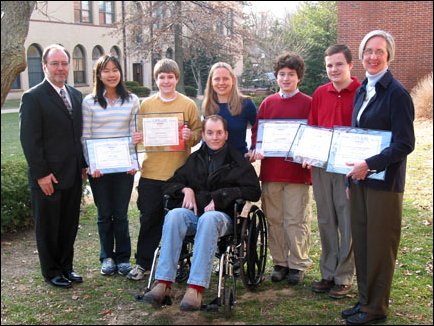

SMAGALS team (from left to right): Paul Cox, the Toshiba representative; Anna Fung; Joel Shuman; Eve Tetzlaff with her husband Jack Orchard, who is in the wheelchair; Lucas Bruton; Michael Hill; and team coach, Mary Harris.
By Scanews Staff
Anna Fung, sophomore of John Burroughs and her team won the second place in the national level of the
Toshiba/NSTA EXPLORAVISION
Program. The award was presented at Washington D.C. from June 11- 15. Each student won a digital camera as well as $ 5,000 in savings bonds.
ExploraVision is sponsored by Toshiba and NSTA (National Science Teachers Association). The idea is to create a technology that could be plausible to use in twenty years. Anna Fung’s team started working on it in late September of 2002, and turned it in late February. The team devised a drug therapy program for patients who suffer from Amyotrophic Lateral Sclerosis, ALS, which is known more commonly as Lou Gehrig's Disease. The project is called SMAGALS: Stop Myelin- Associated Glycoprotein (MAG) for Amyotrophic Lateral Sclerosis (ALS).

Basically, the treatment starts with the motor neurons in the spine of the patient. ALS affects motor neurons so they cannot regenerate, and thus prevents patients from moving; eventually, patients are completely paralyzed and can only breathe with a respirator.
Anna Fung is the only Chinese, and also the only girl in the team. They are all going into ninth grade next year. Project coach's name is Mary Harris, and she is our chemistry teacher at school. They also have a mentor who helped us a lot with the project; Dr. Laura Dugan, neurobiologist at Washington University provided them with a lot of information. The team was inspired to do this project when Jack Orchard, an alumnus from John Burroughs, talked to them about his battle with ALS.
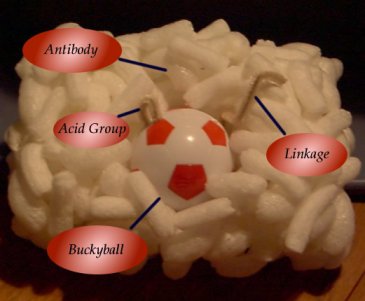
First, the team had to win regionals. They prepared a ten- page paper, and sent it off to ExploraVision. After won regionals, They proceeded to nationals. To qualify for nationals, a website was created by the team. To view our website, the link is
http://www.jburroughs.org/science/mharris/smagals/
Underwritten by Toshiba Corporation, Toshiba America Group Companies and Toshiba America Foundation and administered by NSTA, ExploraVision has become one of the
world's largest K-12 student science competitions and has motivated more than 150,000 students to use their imaginations, to explore science, and perhaps above all - to have fun while learning!
Now in its twelfth year, ExploraVision has continued to grow in popularity with both students and teachers. In fact, many schools across the country incorporate the ExploraVision program into their core science curriculum. Janet Holden, a teacher at Cape Henry Collegiate School in Virginia Beach, Virginia, whose school has been involved with the program for nine years, noted: "ExploraVision helps children develop the ability to think outside of the box, futuristically. They create on their own, without a lot of teacher intervention or parental help. And it's marvelous to see a program that encourages students to work and think independently."
Participating in teams of two to four and guided by a teacher coach and an optional community advisor, students select a technology that is currently used. Teams research and explore what the technology does and how, when, and why it was invented. After imagining what that technology could be like in 20 years, students ground their creative ideas using real science and present their technology vision using written descriptions and artwork. They also discuss the possible positive and negative consequences that could occur should their vision become reality.
In the first phase of the competition, a judging committee will review and select 24 winning projects, one from each of four grade-level categories (K-3; 4-6; 7-9; 10-12) in six regions in the United States and Canada. Each member of the 24 regional winning teams will be awarded a digital camera, and their schools will receive a Toshiba laptop computer and software.
In the second phase of the competition, the 24 regional finalist teams are asked to design Web pages showcasing their technology. The judges then choose eight national finalist teams.
Finalist team members, their parents and coaches are awarded an all-expense-paid trip to Washington, D.C. in June 2003 for a gala awards weekend, during which they will receive their awards. Students from the four first-place teams each receive U.S. Series EE savings bonds worth $10,000 at maturity. Second-place winners receive $5,000 U.S. Series EE savings bonds.
About Toshiba
Toshiba Corporation, based in Tokyo, is a world leader in products involving electronics and energy. Toshiba America, Inc., is the holding company for
Toshiba's six operating companies, with more than 10,000 employees in the United States. Toshiba America Foundation supports K-12 science and mathematics education in United States schools.
About NSTA
The National Science Teachers Association is the largest professional organization in the world committed to promoting excellence and innovation in science teaching and learning for all. NSTA's current membership includes more than 53,000 science teachers, science supervisors, administrators, business and industry representatives, scientists, and others involved in science education.
|