By
ERIN TEXEIRA, AP National Writer
Nov 13, 2005
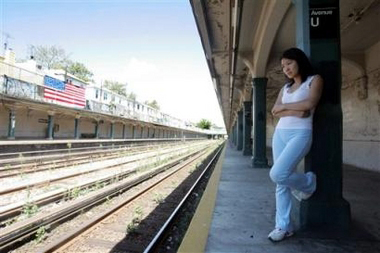
NEW YORK - Eighteen-year-old Chen Tsu was waiting on a Brooklyn
subway platform after school when four high school classmates approached
him and demanded cash. He showed them his empty pockets, but they
attacked him anyway, taking turns pummeling his face.
He was scared and injured - bruised and swollen for several days
- but hardly surprised.
At his school, Lafayette High in Brooklyn, Chinese immigrant
students like him are harassed and bullied so routinely that school
officials in June agreed to a Department of Justice consent decree
to curb alleged "severe and pervasive harassment directed
at Asian-American students by their classmates." Since then,
the Justice Department credits Lafayette officials with addressing
the problem - but the case is far from isolated.
Nationwide, Asian students say they're often beaten, threatened
and called ethnic slurs by other young people, and school safety
data suggest that the problem may be worsening. Youth advocates
say these Asian teens, stereotyped as high-achieving students
who rarely fight back, have for years borne the brunt of ethnic
tension as Asian communities expand and neighborhoods become more
racially diverse.
"We suspect that in areas that have rapidly growing populations
of Asian-Americans, there often times is a sort of culture clashing,"
said Aimee Baldillo of the National Asian Pacific American Legal
Consortium. Youth harassment is "something we see everywhere
in different pockets of the U.S. where there's a large influx
of (Asian) people."
In the last five years, Census data show, Asians - mostly Chinese
- have grown from 5 percent to nearly 10 percent of Brooklyn residents.
In the Bensonhurst neighborhood, historically home to Italian
and Jewish families, more than 20 percent of residents now are
Asian. Those changes have escalated ethnic tension on campuses
such as Lafayette High, according to Khin Mai Aung, staff attorney
at the Asian-American Legal Defense and Education Fund, which
is advocating for Lafayette students.
"The schools are the one place where everyone is forced
to come together," Aung said.
Brooklyn's changes mirror Asian growth nationally. Between 1980
and 2000, the number of Asians and Pacific Islanders grew from
3.7 million to nearly 12 million. After Latinos, Asians are the
nation's fastest-growing ethnic group.
Stories of Asian youth being bullied and worse are common. In
recent years:
?A Chinese middle schooler in San Francisco was mercilessly taunted
until his teacher hid him in her classroom at lunchtime.
?Three Korean-American students were beaten so badly near their
Queens high school that they skipped school for weeks and begged
to be transferred.
?A 16-year-old from Vietnam was killed last year in a massive
brawl in Boston.
Some lawmakers have responded. The New York City Council, after
hearing hours of testimony from Asian youth, last year passed
a bill to track bullying and train educators on prevention. Also
last year, California Assemblywoman Judy Chu won passage of a
new law to allow hate crimes victims more time - up to three years
- to file civil suits; the bill was inspired by a 2003 San Francisco
incident in which five Asian teens were attacked by a mob of youth.
In August, the Oakland-based Asian Pacific Islander Youth Violence
Prevention Center organized a first-ever conference on the subject
in Sacramento. Isami Arifuku, assistant director of the center,
said she expected about 200 participants but nearly double that
number attended.
Experts offer several broad explanations for the bullying problem.
In the broadest strokes, Baldillo said, Asian youth are sometimes
small in stature and often adhere to cultural mores urging them
to avoid confrontation and focus on academics. Many don't report
bullying because they fear repercussions or don't want to embarrass
their families, she added.
Language barriers also exacerbate the situation. "I have
to hear, '(Expletive) Chinese!' at least three times a day, and
they always say it to people who look weaker and don't speak English,"
said Rita Zeng, 19 and a senior at Lafayette High. The parents
of limited-English students often have little access to translators
and struggle to advocate for their children, Aung said.
Chen Tsu described his beating in April at a subway station,
saying through a translator: "Those guys looked like they
could kill somebody. ... I was scared to go back to school."
Increasingly, some victims are fighting back. A 2003 California
survey by the Services and Advocacy for Asian Youth Consortium
found that 14 percent of Asian youth said they join gangs for
protection. Department of Justice school crime data found the
number of Asian youth carrying weapons nearly tripled from 1999
to 2001.
"There are more Asian kids being brought to juvenile court
for assault and battery," Arifuku said. "The thing we're
finding in their history is that they had been picked on - called
names and teased - and in some cases they lashed out and retaliated."
Advocates and students say that, typically, large fights erupt
after weeks or months of verbal taunting.
That's what happened at Edison High School in Fresno, Calif.,
according to Malcolm Yeung of the Asian Law Caucus in San Francisco.
For months starting late last year, Hmong students had been repeatedly
called names and had food thrown at them.
"There had been patterns of this happening over and over
again," said Yeung, whose group investigated the case on
behalf of Asian students. "But the school had overlooked
the issue."
On Feb. 25, the lunchtime taunting escalated into fights involving
at least 30 students, according to Susan Bedi, spokesman for Fresno
Unified School District. Seven students were treated for injuries,
12 were suspended and two faced expulsion, she said. Eight were
convicted of misdemeanor assault, said Fresno police Sgt. Anthony
Martinez.
This year, officials at Edison High added more security and started
an on-campus human relations council to address ethnic tension,
Bedi said.
At Lafayette High, tension has long been high on campus and in
surrounding areas, said Steve Chung, president of the United Chinese
Association of Brooklyn, whose group was founded in late 2002
after an earlier student beating. That incident "was like
the ignition - it started a fire" in the community.
The student, a straight-A senior, was thrashed to unconsciousness
while anti-Chinese slurs were yelled at him. Some news reported
dubbed the school "Horror High," and Chinese students
began going public about the problem.
"The more we dug into Lafayette High School, the more we
found," Chung said.
Aung's probing revealed that school administrators seemed reluctant
to intervene, translation services for parents and students was
spotty and teachers who reported the problems may have been punished.
School officials say some reports were exaggerated. But "the
problems there went back many, many years," said Michael
Best, general counsel for New York City schools. Since signing
the consent decree in June, he said, "the situation at the
school in our view is very, very different." A Justice Department
spokesman agreed that the school has been "very responsive."
Teachers this year are getting training to curb harassment, translation
services throughout the district have been beefed up, and race
relations experts are working with students and staff on campus,
deputy New York schools chancellor Carmen Farina said.
Last year, Lafayette's longtime principal retired, and many are
optimistic about the new principal, Jolanta Rohloff. In addition,
new vice principal Iris Chiu is fluent in Chinese and working
closely with parents and students. "We actively sought someone
that we knew could handle the delicacy of the school," Farina
said.
Still, she said, an incident already has been reported since
school started: An Asian student was attacked by several classmates
on his way to the subway. He suffered minor injuries.
|