I remember the first time I preached in a combined worship service was on the first Sunday of January 2005. The title of my sermon was "New Year, New Life", and it was based on Philippians 3:10-14. I encouraged you to have Paul's constancy of purpose, his positive optimistic attitude, and his heavenly motivation. You all know my English name is Timothy. It was not a name given to me by my parents. I named myself Timothy after I came to this country to show that I was willing to learn from Paul, since Paul was Timothy's spiritual father and dearest teacher. In almost four years of serving at this church, I have held fast to the purpose of accomplishing the Great Commission through this church, maintained a very positive optimistic attitude by forgetting what was behind and straining toward what was ahead, and pressed on toward the goal to win the prize for which God has called me heavenward in Christ Jesus. Four years ago when I came as a pastoral candidate, I mentioned I came to CGC with the same spirit that Lewis and Clark had had when they explored the American West more than two centuries ago. They obeyed the order of President Jefferson and completed their survey mission despite all the obstacles they faced. I have also mentioned that pasturing a church was a tough job, but under the command of our God in heaven, I was willing to fulfill my duty, just like how Lewis and Clark fulfilled their duty despite all the obstacles and challenges. Since it was a duty given by God, I felt it was natural that I should serve at CGC, though the past four years were not trouble-free. But if I were to go back to four years ago and make a choice among the four churches that invited me to be their pastor, I would still choose to serve at CGC. At this church, my wife and I have received much love from you. I believe we can echo what Paul said in his letter to the Philippians: "I thank my God every time I remember you." "In all my prayers for all of you, I always pray with joy."Today is my last sermon in a combined service. Naturally, I think of Paul. After he finished his third mission journey, on his way back to Jerusalem he bid his farewell to the church at Ephesus (Acts 20:17-35). What he said is still applicable to us.
I. Witness that he preached the whole counsel of God. (vv. 26,27)Ephesus was the largest city in the province of Asia Minor (today it is the country of Turkey). Because it was a major metropolitan area, Paul stayed there during his third mission journey and worked there for three years. Now Paul was sailing from Greece back to Jerusalem. He arrived at the seaport called Miletus right outside of Ephesus. He sent someone to Ephesus to fetch the elders from the church. He asked the elders to witness for him before God and give a strong testimony at his death. He solemnly said, "Therefore, I declare to you today that I am innocent of the blood of all men, for I have not hesitated to proclaim to you the whole will of God."
Here we see how significant God's will was in the heart of apostle Paul. In the original Greek text, it includes all the doctrines of the Christian faith. He taught them all the doctrines of their faith, which was also the will of God. He proclaimed to them the complete Gospel.
We as preachers should be like Paul. We must clearly teach the great love God the Father had for His children before He created the universe, His absolute election and predestination, the purpose of His covenant with them, and His unchangeable promise for His children. In addition, a preacher must also teach about the perfectness of Lord Jesus, the glory of His person, the fullness of His work, and most importantly, the efficacy of His precious blood. We could forget to mention other things, but we must never forget to teach the truths regarding Lord Jesus. That's the reason why the President of Covenant Seminary, Bryan Chapell, said: "Every sermon has to be Christ-centered." Because we believe in the truiune God, we must also teach about the Holy Spirit, proclaim how He brings rebirth and sanctification and how He protects the true believers. Without the power of the Holy Spirit, our work and preaching will be nothing but a resounding gong or a clanging cymbal. We would be unable to bring real change. We must magnify the Holy Spirit, and let His power show in our service and ministry.
We as preachers must clearly preach the whole counsel of God. We must carefully preach God's predestination and His election. We must teach God's efficacious call, justification by faith, and preservation of saints. Because we were elected by God, we were cleansed by the precious blood of Jesus. Because God has established a covenant with the chosen, He will not abandon us.
But as a preacher, if he wants to preach the whole will of god, he must not limit his preaching to the doctrines about grace. He must also teach about the human responsibilities, and the way we shall live. If he does not teach that the fall of a sinner is his own responsibility, if he does not teach about the punishment in hell as the result of not accepting Jesus as the only savior, then he has not preached the whole will of God. If a preacher does not preached both the doctrine of God's sovereignty and the doctrine of human responsibility, he is an unfaithful servant. I believe when a person suffers in hell, he has no one to blame but himself. I would say to them, "You were not willing to accept Jesus." "You were not wiling to confess." "You were not willing to accept the conviction by your conscience." "You were invited by Jesus to attend His feast, but you refused to go." "Jesus knocked on the door of your heart, but you did not open." "Jesus extended His hands to you, but you refused his salvation." "Now you are suffering in hell, and it is all your responsibility." When apostle Paul wrote about the whole will of God, he taught both the human responsibility and God's election and predestination.
When Paul bid his farewell to the elders in Ephesus, he said, "Therefore I declare to you today, that I am innocent of the blood of all men. For I have not hesitated to proclaim to you the whole will of God." Today, I would also like to ask you to testify that I have preached God's whole will to you without any reservation. In the last three and a half years, I have preached on a series of doctrine. I taught the truth about the triune God. I preached to you that we were chosen by God's grace. On the other hand, I have not avoided inviting you and pleading to you! I wish for sinners to trust in Jesus. I worry about the souls of you who have not yet believed. I have been praying for you and crying out to you. "Accept Jesus! O sinners, believe in Jesus." If you have not yet put your trust in Jesus, that is not because I have not preached the gospel to you, or I have not pleaded to you! Today I hope you can be my witness. If you do not believe and enter into eternal damnation, that is not my fault. Like Paul said, "I am innocent of the blood of all men, for I have not hesitated to proclaim to you the whole will of God."
II. Encourage the church elders. (v. 28)
Second, Paul said to the elders of the Ephesian church, "Keep watch over yourselves and all the flock of which the Holy Spirit has made you overseers; be shepherds of the church of God, which he bought with His own blood." Here Paul reminded the elders to be good overseers of the flock, and the shepherds of the church of God. They must keep watch over their own acts, keep watch over their work as shepherds of the church, keep watch over the church.
During my three years at CGC, the elders and two pastors read a book called "The Practices of a Healthy Church" written by Rev. Don MacNair. He was the senior pastor of the Covenant Presbyterian Church in St Louis. In the Foreword of that book, Bryan Chapell, the president of Covenant Seminary, gave high recommendations for this book. He praised MacNair as his dear friend and mentor.
In that book, MacNair based his teachings on the Bible and on Paul's farewell to encourage the elders to be responsible for shepherding the church. He knew that in a church that is ruled by elders, the quality of elders is very important. He said the health of a church is closely related to how well the elders serve. Paul told the elders at Ephesus that the Holy Spirit had made them overseers of the flock. Therefore, God will hold elders accountable for the spiritual situation of a church. An elder must actively develop his relationship with church members as a shepherd. He must care for them and protect them. An elder must be like the shepherd describe in John 10; he must love his flock with a sacrificial love. He must express this love through visitations and prayers. An elder must also equip believers for spiritual work. He must encourage and train them. In Paul's encouragement, he said elders should keep watch over the whole flock. Elders are the keepers of God's words and God's flock. For elders to protect the church, they must teach God's truth and the Bible. Elders must diligently study the Bible, so that they can teach and shepherd well. In the Presbyterian Churches of America, elders must pass ordination examinations. Why must we be so stringent on elders? Because Paul said elders must keep watch over themselves and all the flock. Because the church is precious, and the flock in a church is also precious. They were bought by the precious blood of Jesus.
III. Warn against the future dangers. (vv. 29,30)
Third, after Paul encouraged the elders, he talked about the dangers that the church faced. He said, "I know that after I leave, savage wolves will come in among you and will not spare the flock. Even from your own number, men will arise and distort the truth in order to draw away disciples after them."
Today all the American churches face some severe challenges. Although the United States was founded on the basis of Christianity, the church has a diminishing influence on the society. Europe was originally the so called Christendom. But today in Europe, churches are very weak. Few people go to worship in churches every Sunday. What caused the change in Europe? Mainly because in the 19th century, some theologians and Bible scholars at universities criticized the Bible. Under the banner of freedom in research, they attacked the Bible with unfounded theories, and denied the divinity of Jesus. Because of their unbelief, pastors who learned from them also did not believe that the Bible is the word of God. They did not have God's message to help believers spiritually. When lay believers came to church but could not get spiritual nourishment, they lost the need to come to church, and that made the European churches powerless.
The crisis American churches are facing has its roots in overall cultural changes. Currently the mainstream American worldview is the so-called post-modernism. Most people accept that there are no right and wrong in thoughts and ideas. Everyone can have different perspectives. Such a view is being taught in higher education: There is no truth; there is only individual or group preference. Under the worldview of post-modernism, the Bible cannot be the word of God, or the universal truth, and certainly people will not study the Bible diligently.
Our church is situated in this American environment. We are also being affected by post-modernism. This is the danger we will face, and is also the danger all American churches will face.
Paul closed his encouragement to the elders at Ephesian church by saying, "So be on your guard! Remember that for three years I never stopped warning each of you night and day with tears. Now I commit you to God, and to the word of his grace, which can build you up, and give you an inheritance among all those who are sanctified." In this last combined service, I commit CGC to God and His word of grace. May God keep the church He established with his own hands. May the Lord keep the church that he bought with His own blood. Amen.
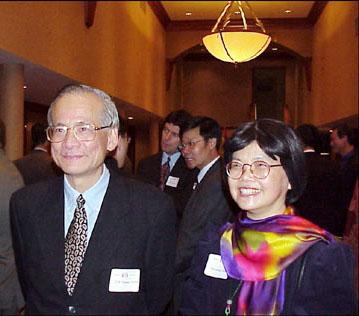
(Rev. Dr. Tar Timothy Chen preached this sermon in Mandarin at the Chinese-English combined service of St. Louis Chinese Gospel Church on August 3, 2008. He thanks Stewart Hoi for interpreting into English during his preaching and providing this English manuscript.)
Editor Note: Farewell Party for Pastor Chen and Mrs. Chen: Sun. 8/17/2008 immediately after lunch at St. Louis Chinese Gospel Church at around 1:45 p.m.- Farewell Party sponsored by the church for Pastor Chen and Mrs. Chen.
St. Louis Chinese Gospel Church515 Meramec Station RoadSt Louis, Mo 63021Tel: 636-391-2112Fax: 636-391-1915e-mail: stlcgc@stlcgc.orghttp://www.stlcgc.org/
|