WASHINGTON, D.C. - Among Asian American voters, many are supporting presidentialcandidate Barack Obama, but another sizable portion remains undecided - a development that couldset the stage for Asian Americans to play a pivotal role in the outcome of the election, according toa new national survey released today.
This groundbreaking study, released at a Washington, D.C., press conference this morning, wasconducted by researchers from four leading universities: Rutgers, The State University of NewJersey; University of California, Berkeley (UC Berkeley); University of California, Riverside (UCRiverside); and University of Southern California (USC).
The researchers' 2008 National Asian American Survey (NAAS) shows that 41 percent of AsianAmericans are likely to favor Obama, while 24 percent support John McCain. In battlegroundstates, where either candidate could win on Election Day, Obama leads with 43 percent of AsianAmericans supporting him and 22 percent favoring McCain.
Researchers point out that a key finding of the study is the high proportion of undecided AsianAmerican likely voters: 34 percent. Among the general population, national polls conducted sincethe major party conventions show that undecided voters are approximately 8 percent of theelectorate.
Karthick Ramakrishnan, an associate professor of political science at UC Riverside, points out that"with such a high proportion of undecided voters, Asian Americans are a critical source of potentialvotes for either candidate in the final weeks of the campaign." 𡌃ven in battleground states andamong those Asian Americans who were interviewed in the second half of September, more than 30percent were undecided between Barack Obama and John McCain,?he says.
The multi-ethnic, multi-lingual survey of more than 4,000 Asian Americans likely to vote in theelection was conducted from Aug. 18 to Sept. 26. It is the most comprehensive survey to date of thepolitical views of Asian Americans, with interviews conducted in English, Cantonese, Mandarin,Hindi, Japanese, Korean, Tagalog and Vietnamese.
Janelle Wong, an associate professor of political science at USC, says that "most national pollscannot report the preferences of these likely voters because they do not interview in multiplelanguages, and the number of interviews they conduct among Asian Americans is very small."By drawing on the knowledge of political scientists with expertise in survey research and ethnicpolitics, and with support from several foundations, the NAAS data provide insight about AsianAmericans as a whole, the researchers say, as well as about their six largest ethnic subgroups: AsianIndians, Chinese, Filipinos, Japanese, Koreans and Vietnamese.
The research shows that support for the candidates does vary by Asian American ethnic groups.Among those who have made up their mind on a candidate, two-thirds of Vietnamese Americanssupport McCain; Japanese Americans, Chinese Americans, and Indian Americans support Obamaby more than a three-to-one ratio; and Korean and Filipino Americans who are likely voters alsosupport Obama over McCain, but the gap is much smaller, with ratios less than 1.4 to 1.
Many of the differences can be attributed to party affiliation, according to the researchers.Vietnamese Americans identify with the Republican Party over the Democratic Party by nearly atwo-to-one ratio, while the opposite is true for other ethnic groups such as Indian Americans andChinese Americans.
Still, as UC Berkeley associate professor of political science Taeku Lee says, "A very large numberof Asian Americans are non-partisan. The Asian American vote is very much up for grabs: Nonpartisanswho see either the Democratic or Republican party as closer to them on issues that matterto them are much likelier to vote for that party's candidate."
Among the survey's other findings:
The majority of Asian Americans who voted in the primary supported Hillary Clinton over Obamaby nearly 2 to 1; but 59% of Clinton supporters now plan to vote for Obama and 10 percent supportMcCain.
About 80 percent of likely voters who are Asian American list the economy as one of the mostimportant problems the nation faces, followed by the war in Iraq. On both issues, there are stronglydivided opinions between Obama and McCain supporters. "Even as the Iraq war has receded fromthe headlines as concerns about the economy have become more prominent, the war still plays apowerful role in the Asian American choice for president," says Jane Junn, an associate professor ofpolitical science at Rutgers.
Overall, 32 percent of all Asian Americans identify themselves as Democrats; 14 percent asRepublicans; 19 percent as independents; and 35 percent as nonpartisan, not fitting into any of themajor party categories.
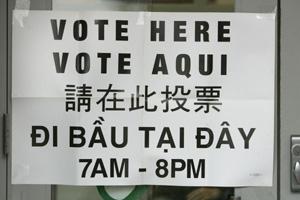
One third of Asian American citizens get informed about politics from Asian-language televisionand newspapers, and more than one in four (28%) say they would use Asian-language ballotmaterials.
Next to Latinos, Asian Americans are the fastest growing share of the U.S. population. Currently,they comprise 5 percent of the population and, according to the researchers, will likely play asignificant role in battleground states such as Virginia, Nevada and Washington, where they accountfor 5 percent or more of the population. Even in states such as Colorado, Ohio and Florida, wherethey are less numerous, Asian Americans may provide the margin of victory, the researchers said.
The full NAAS report, including information on the survey methodology used, will beposted online at: http://www.naasurvey.com/. |