One of the four going forward regional strategic initiatives that the RCGA Board of Directors has adopted for priority focus in the years ahead is "Leveraging the Region's Locational Advantage". There are several elements in this initiative --- such as taking full advantage of the "Big Idea" China Project for making the bi-state St. Louis region the hub for the center of the U.S., as well as significantly enhancing our already considerable assets in freight and distribution infrastructure. A third element of this initiative is establishing a high-speed passenger rail link between St. Louis and Chicago.
In fact, part of the rationale for choosing Chicago last Fall for the RCGA Annual Leadership Trip was to advance this initiative as part of the overall issue of how St. Louis can establish stronger links between our region and Chicago as part of a broader, mega-regional strategy. While the issue of high-speed passenger rail in the U.S. in general, and the proposed initiative in the Midwest in particular, is a very long-term effort, early-stage progress on this issue has been significant.
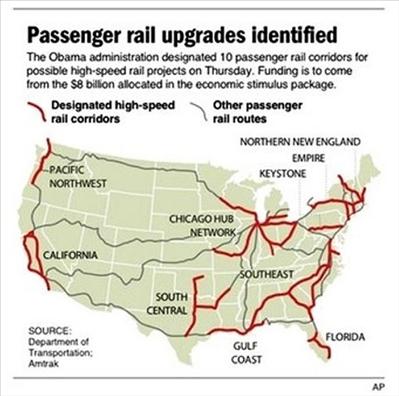
This past Thursday, President Barack Obama and DOT Secretary Ray LaHood announced plans for a high-speed railway system in the U.S., with the President noting, "My high-speed rail proposal will lead to innovations that change the way we travel in America. We must start developing clean, energy-efficient transportation that will define our regions for centuries to come. Such a system would also create thousands of jobs." The President identified $8 billion from the recently-enacted economic stimulus package as a "down payment" on the high-speed rail system.The focus on Chicago as one of the four finalists for the 2016 Olympic Games creates added logic for St. Louis and other Midwestern regions to be considered as extended parts of a Chicago mega-region. This past week, Illinois Gov. Pat Quinn, Missouri Gov. Jay Nixon, Indiana Gov. Mitch Daniels, Iowa Gov. Chet Culver, Michigan Gov. Jennifer Granholm, Minnesota Gov. Tim Pawlenty, Ohio Gov. Ted Strickland, Wisconsin Gov. Jim Doyle and Chicago Mayor Richard Daley joined in support of high-speed passenger rail projects to link cities in their regions, with Chicago as the hub.
These elected leaders have sent a joint letter to Secretary LaHood asking him to support plans that have been in place for several years for key rail corridors between cities in their states, including St. Louis to Chicago. The Governors and Mayor Daley are seeking funding for the projects through the American Recovery and Reinvestment Act, which mandates funding for improving and deploying high-speed rail systems in the U.S. The letter presents the case that the Midwest Regional Rail Initiative, first conceived by Missouri and 8 other states in the mid-1990s, has done the needed studies and preliminary work for projects that would provide increased mobility for travelers and promote regional and economic development goals.
The Phase I corridors would include Chicago-St. Louis, Chicago-Milwaukee-Madison and Chicago-Detroit-Pontiac. High-speed trains between these cities initially would travel at 110 miles per hour. Governor Nixon noted that Illinois already has completed an environmental impact statement for the Chicago-St. Louis corridor. The joint letter by the Governors states that, with American Recovery and Reinvestment Act funds, projects in these corridors can be completed between 2012 and 2014. Preliminary engineering estimates indicate that the Phase I projects will require approximately $3.4 billion for track and operating equipment.
After initial phase projects would be completed, the Midwest Regional Rail Initiative calls for developing service along other routes, including St. Louis to Kansas City.
For a number of years, the focus on issues such as high-speed rail has been limited to a fairly targeted group of railroad and high-speed rail advocates, including some members of the RCGA and the active involvement over the past several years of RCGA Vice President for Infrastructure Susan Stauder. In the past 12 months, the constituency of this idea has dramatically expanded and is beginning to be seen as an important infrastructure aspiration for the U.S. as part of both transportation and an economic development strategy.
It is significant that both the Civic Progress and RCGA have identified this issue as a civic priority for the region. |