by Zheng Qinyan
To see a world in a grain of sand,And a heaven in a wild flower,Hold infinity in the palm of your hand,And eternity in an hour. ---- William Blake
The history of the Chinese fan and its culture stretches back thousands of years. The petite fan that was once used simply to induce airflow for cooling unexpectedly became the subject of sentimental expression. Through the careful selection of artisans and an insistence on fine craftsmanship, fans have been transformed from tools into rare collector items. Over the millennia, a delicate fan culture swept the lands of China and became yet another manifestation of taste and elegance.
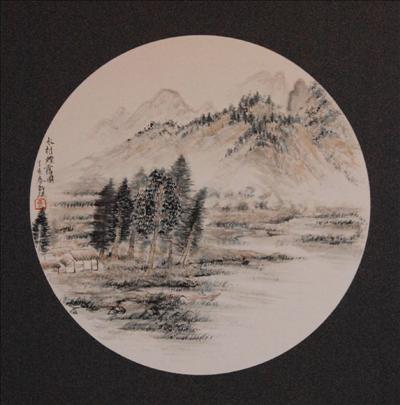
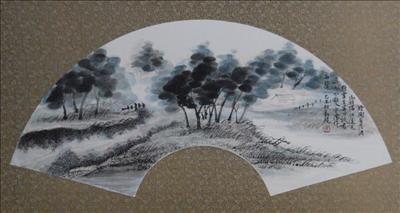
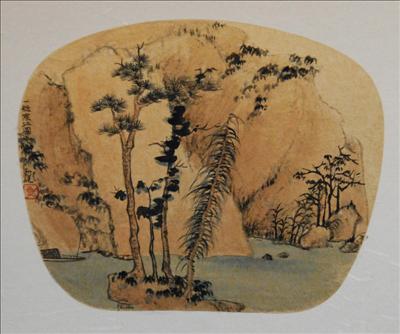
The origin of the fan can be traced back to the time of Emperor Shun, about 4,000 years ago. The round silk fan with a handle, also called the Tuan Shan, was already in use among affluent ladies during the Han Dynasty. Later, materials such as silk, paper, feathers and palm leaves were added to the repertoire. Graphics commonly painted included beautiful scenery, human portraits, flowers and birds. The choice of frame is yet another critical procedure. A wide spectrum of materials, including red sandal, ivory and ebony, have been used to achieve different practical and aesthetic results. Meanwhile, various methods of inlaying, embedding, painting and bronzing for decoration took the art to its culmination.
With poetry, calligraphy, painting and seal imprints all integrated into the design, the painter's emotional strokes, applied with exquisite touch, turned the practical device into an artistic delight. The sea of emotions implicit in the fan has made it a prime medium for expressing people's sentiments and desires. Whether sorrow or debauchery, joyfulness or calm, vivacity or transcendence, any human feeling could find its equivalent harbored in the art of fan. Meanwhile, derivative art forms such as fan dance, fan poetry, fan couplet, gradually developed their own schools. As a result, the fan has become a distinct cultural symbol, a representative image.
In my world of fan art, the moralities of mountain, the imagery of plum and orchid both surpass my expression, the craving for such attainment can be inhibited.(1) All my understanding of the world and comprehension of life lie within the flow of the brush. As one Buddhist hymn goes: The world is in a flower, all time is in an hour; one fist holds immensity, one moment entails eternity. The fan's minute few inches, embodying the grandness of the universe, represent my pursuit of selfhood and aesthetic feeling. Immersing myself in the world of fan art, accompanied by the gentle breeze and limpid air, I am witnessing the epitome of the world. Thus, the affection for beauty, the treasuring of the real, the veneration of the noble, the pacification of emotions, the emancipation of thoughts, the rectifying of deeds, all comprise my ultimate pursuit of the good. Yes, the power resides within the universe, the fan, me.
(1) Plum, orchid, bamboo, chrysanthemum, or the 焅our Gentleman,?are symbols that represent noble characters in Chinese paintings.
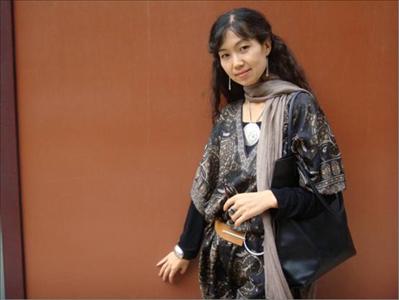
Qinyan Zheng
Qinyan Zheng is an art educator, Chinese landscape painter, calligrapher and author.
She serves as a member of the Affiliate Youth Committee of the Chinese Central Government, the Chinese American-European Scholarship Society, the American Art Education Association, and the Chinese Jury of the PHE - International Teenagers' Visual Arts Competition.
In 1998 she received a bachelor's degree in Chinese Painting and in 2001 a master's degree in Art Education from China's Northwest Normal University. In 2004 she was awarded a PhD in Fine Arts from Capital Normal University, Beijing.
Zheng's works have been exhibited in various exhibitions - mostly solo shows - in museums and galleries in numerous countries and are collected by private and public institutions alike. To date, she has published 6 books, mostly about art education in China, and more than 50 articles in Taiwan World Forum Newspaper, Dunhuang Research , China Fine Arts Education and other newspapers and magazines.
A number of Chinese television stations did biographical segments on Zheng in 2005 and 2007. In 2008, she became host of the interview program "Chinese Arts Legend" on Sina Internet.
Zheng has been an Assistant Professor at the Central Academy of Fine Arts since 2004, and founded the Qinyan Art Education Center in Beijing in 2007. She has also initiated several influential cultural exchange programs between China and the United States. She was a visiting scholar at Columbia University in New York in 2007 and 2008. In addition, she has presented courses, workshops, and lectures on Chinese Art and Art Education at several American universities. |