|
 |
|
|
|
|
|
|
|
|
Issue: 1029 Date: 5/13/2010
|
|
Kinder Touts Impact of Missouri's Historic Preservation Program
|
|
|
|
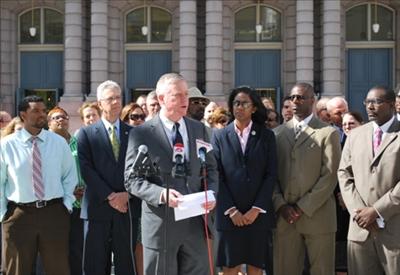 |
| Lt. Governor Peter Kinder (center) is joined by (from left) St. Louis Alderman Antonio French, President of the Associated General Contractors of St. Louis Leonard Toenjes, Missouri Rep. Tishaura Jones (D-downtown St. Louis), Alderman Jeffrey Boyd, and Board of Aldermen President Lewis Reed. |
|
|
Last week Lt. Governor Peter Kinder held a news conference in downtown St. Louis with St. Louis Board of Aldermen President Lewis Reed and other elected officials to emphasize the importance of the Missouri Historic Preservation tax credit program to the revitalization of downtown St. Louis, saying that "but for" the use of the credits, most of the rehabilitation projects like the Old Post Office would not have been economically feasible. Kinder stated that he was strongly opposed to subjecting the program to the discretion of the Missouri Department of Economic Development, saying it could lead to "pay to play" politics, and maintained that education and economic development should go hand in hand, not be pitted against each other as Governor Jay Nixon has recently attempted to do.
The RCGA has been a long-time supporter of the Historic Preservation program, which has been a major catalyst to the revitalization of downtown St. Louis by leveraging at least $4 in private investment for every $1 of state tax credits invested. Over the past 15 years the program has spurred nearly $5 billion in private investment in downtown St. Louis. The RCGA strongly opposes all efforts to reduce the effectiveness of proven tax credit programs, including proposals to subject them to the annual appropriations process.
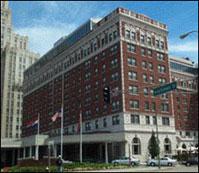
Historic preservation projects can do more than simply rehabilitate an old building--they can help revitalize whole communities, as was the case with the Chase Park Plaza (pictured right). The building, built in the 1920s, closed in 1989 after falling into a state of neglect and disrepair. After seeing the effect this was having on the surrounding neighborhood in the late 1990s, a group of investors leveraged $20 million in state Historic Preservation tax credits to complete the $137 million renovation of the building. The Chase Park Plaza reopened in 1999 with more than one million square feet of guest suites, apartments, restaurants, and banquet and meeting facilities. The project, which created 150 permanent jobs, has had a profound ripple effect on St. Louis' Central West End, serving as an anchor for the neighborhood's revitalization and success.
|
|
 |
|
|
|


