|
 |
|
|
|
|
|
|
|
|
Issue: 1082 Date: 5/19/2011
|
|
Missouri Legislature fails to pass China Hub incentives, local control
|
|
|
|
|
|
 |
|
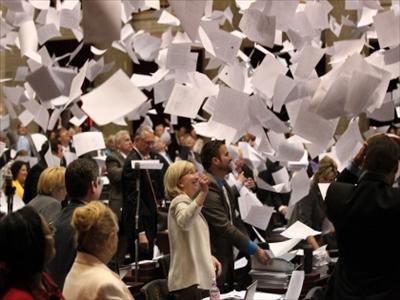
| Members of the Missouri House of Representatives celebrate the end of the 96th General Assembly by throwing papers into the air at the State Capitol in Jefferson City on May 13, 2011. UPI/Bill Greenblatt |
|
|
JEFFERSON CITY - The last day of the Missouri Legislature's session was supposed to be St. Louis Day.
City Hall had hoped to gain control of its Police Department for the first time in 150 years.
St. Louis leaders also had lobbied hard for an ambitious plan to subsidize a foreign freight hub at Lambert-St. Louis International Airport.
But both measures died Friday after negotiations between the House and Senate blew up. The result was a stinging defeat for St. Louis Mayor Francis Slay.
"As far as I know, there wasn't really any opposition to the (local control) bill, in terms of merit," Slay said. "It was used as a pawn."
Slay promised to pursue with as much "energy and vigor as we can" the city's Plan B: a voter initiative campaign funded by millionaire Rex Sinquefield.
"This is definitely a disappointing moment," Slay said as the legislative session came to a close, "but it is not the last moment."
The demise of the economic development bill led some to urge Gov. Jay Nixon to call a special legislative session this summer, especially to reconsider the $360 million in tax credits aimed at nurturing a China hub at Lambert.
Nixon said, for the moment at least, he doesn't see enough consensus on the China hub bill to warrant a special session.
"We're not going to call folks into a special session to have a taxpayer-funded debating society," Nixon said.
Dick Fleming, president of the St. Louis Regional Chamber and Growth Association, expressed disappointment with the Legislature's failure on economic development issues.
"It's hard to imagine that we as a region and a state want to go another year with nothing happening on comprehensive economic development legislation," he said. "The rest of the country is eating our lunch."
Republicans control the Legislature with historic majorities. Before several members left for other jobs, the GOP ruled the House 106-57. Republicans are even more dominant in the Senate, where they hold 26 seats to the Democrats' eight members.
The governor, a Democrat, lost key battles this session when the Legislature balked at letting utilities charge customers for the costs of obtaining an early site permit for a second nuclear reactor in Callaway County and overrode his veto of a congressional redistricting map.
The new map eliminates the seat of U.S. Rep. Russ Carnahan, D-St. Louis, bringing the state's representation in Congress to six Republicans and two Democrats. The state lost a seat because Missouri's population growth did not keep pace with other states.
Legislators also rebuffed Nixon's proposal to require a prescription to buy some cold and allergy medicines with pseudo ephedrine, an ingredient used in making methamphetamine.
But Nixon salvaged some priorities on the final day, including renewal of Missouri RX, a $20 million program that helps elderly and disabled Missourians buy medicine.
Other measures gaining last-minute approval would move the state's presidential primary from February to March and lower the minimum age to obtain a concealed gun permit to age 21 from 23.
But the star attraction ?the tax credit bill ?didn't make an appearance until 45 minutes before adjournment Friday when the House attempted a compromise. The Senate didn't take it up and quit 10 minutes before the session's mandatory 6 p.m. conclusion.
The House and Senate have battled for months over tax credits, which cost the state $522 million last year. Senators say the cost must be brought under control while House members say the programs are successful and generate revenue.
The biggest fight concerns the credit that helps developers rehab historic buildings, an outlay that has been popular in St. Louis.
Missouri authorized $99.5 million in historic preservation credits last year. The Senate wanted to cap the program at $75 million while the House preferred $115 million but would have settled for $90 million.
"We've met the Senate 85 percent of the way," said the House's chief negotiator, Rep. John Diehl, R-Town and Country.
In the end, the two chambers locked horns over accountability questions, such as whether to set a four-year expiration date on the program and whether to give the Missouri Department of Economic Development discretion in handing out the credits.
The impasse stymied not only the airport tax credit sought by Slay and St. Louis business leaders, but also the bill giving St. Louis control of its Police Department for the first time since the Civil War.
Slay and the St. Louis Police Officers Association had negotiated an agreement protecting officers' pensions and benefits, removing the group's opposition.
But Senate Republicans held the local control bill hostage in an attempt to get House Republicans to agree to the tax credit overhaul. The local control bill died when senators never brought it up for a final vote.
Despite the setback, that issue won't go away. Retired St. Louis investor Rex Sinquefield is financing an initiative petition drive to give both St. Louis and Kansas City control of their police departments. State boards run both agencies now.
Travis Brown, a lobbyist for Sinquefield, said the campaign, called A Safer Missouri, has already collected 10,000 signatures toward the roughly 90,000 needed to put the issue on the November 2012 ballot.
other issues
Earlier in the session, legislators passed bills rewriting dog breeding regulations, banning most late-term abortions, placing on the 2012 ballot a photo ID requirement for voting and requiring drug tests for some welfare recipients.
Republicans proponents said the drug testing legislation would keep tax dollars from being used to fund drug abuse. Democrats said the bill unfairly targeted one group receiving federal funding.
Under the measure, drug users would lose benefits for three years unless they enter into a treatment program. Determining whether to test someone would be based on a "reasonable suspicion" that a person is using drugs.
While approving that longtime Republican priority, legislators squashed one of the main proposals of House Speaker Steven Tilley, R-Perryville: to require that drivers license tests be administered only in English or American Sign Language.
Meanwhile, business groups secured several victories, including a bill phasing out the franchise tax on business assets over the next five years. It is levied on assets exceeding $10 million.
Some Democrats said the state couldn't afford the tax cut.
"They gave away $85 million, and we didn't get one job out of that," said Rep. Rory Ellinger, D-University City.
Earlier, legislators passed a $23 billion budget a day before the constitutional deadline, holding taxes steady and keeping aid to public schools stable.
Nixon said the budget is $90 million out of balance and will have to be trimmed.
But it could have been worse.
A few hours before adjournment, legislators passed a bill that will renew taxes paid by medical providers such as hospitals, nursing homes and managed care companies. The taxes generate revenue that draws federal matching funds, forming the foundation of the state's Medicaid program. Without the legislation, the taxes would have expired in September.
Some unresolved issues could end up in court.
Legislators who wanted to broaden school choice options sidelined a bill that would have let school districts limit how many students they accept from neighboring unaccredited districts, such as St. Louis Public Schools.
Also on the scrap heap: a bill fixing a funding problem with the state's Second Injury Fund, which covers certain workplace injuries that aggravate pre-existing disabilities. The fund is predicted to go bankrupt this year. Attorney General Chris Koster, whose staff handles the fund, had lobbied for the legislation.
Rebecca Berg, Jason Hancock, Tim Logan and Jake Wagman of the Post-Dispatch contributed to this report.
(VIRGINIA YOUNG, Post-Dispatch, May 14, 2011)
|
|
 |
|
|
|


