|
 |
|
|
|
|
|
|
|
Issue: 1204 Date: 9/18/2013
Become A Fan, Like St. Louis Chinese American News


|
|
National Leaders, Global Entrepreneurs and Teenagers:
The Promise of the US-China Youth Leadership Exchange |
|
|
| 請您關注和惠顧聖路易時報的廣告客戶,並向朋友推薦聖路易時報,感謝您的支持! |
|
|
|
 |
|
|
|
|
By Bob Holden, Chairman, US-Midwest China Association
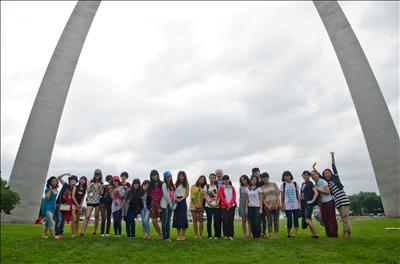
This past summer the seeds of what could become greater international diplomacy and commerce were planted on the campus of the University of Central Missouri in Warrensburg. Side-by-side, smile-by-smile, with the youthful ease and curiosity of teenagers who know no borders, a group of 36 students from 11 different provinces and municipalities in China took part in the American Legion Missouri Boys State and American Legion Auxiliary Missouri Girls State programs. Boys and Girls State, as the program is known collectively, is one of the most respected educational programs in the country for inspiring young people to become involved in their government, rather than sitting on the sidelines as mere critics. Participants learn the rights, privileges and responsibilities of franchised citizens and the leadership skills which they gain in the process are invaluable. In its 78 year history, this iconic American program has shaped some of our nation's most noteable leaders. This first-ever international convening, called the US-China Youth Leadership Exchange, will help shape the global leaders of tomorrow.
It is worth noting, and with time might prove to be providential, that the American and Chinese students sitting down at a cafeteria table in mid-June in middle America was preceded and followed by US-Chinese meetings of the highest order, first on the West Coast and then the East. President Obama and Chinese President Xi Jinping sat down to the dinner table at the Sunnylands Summit in California in early June, as part of a two-day meeting to set the strategic tone and direction for an evolving US-China relationship. Just days after the Chinese students left Missouri for home, a high-level delegation of Cabinet members, ministers, agency heads, and senior officials from both countries sat down at the negotiating table in Washington, D.C. They were there for the US-China Strategic and Economic Dialogue (S&ED), thefollow-on to the summit in California. The meeting of the S&ED provided an opportunity to begin to implement that strategic framework, with small but concrete steps towards progress on a multitude of issues ranging from a Bilateral Investment Treaty (BIT) to cyber-security. High-level talks such as this, begin to facilitate transparency and practical cooperation on major issues which impact the developing economic relationship.
The stakes are certainly high. In the second quarter of 2013, Chinese investment in the US grew by $2.5 billion, according to the Rhodium Group, bringing Chinese investments to $4.7 billion in the first half of 2013. $48 million of that investment occurred in the Midwest United States alone. With this being the strongest investment period on record, the timing of these multi-layered US-Sino meetings could not be more appropriately timed. To suggest that a cultural exchange between seventeen-year-olds compares in any way to the magnitude of the discussions detailed above would be a reach, but to offer that some day they might, would be rooted in actual history.
In 1985, a 33-year old Xi Jinping arrived in Muscatine, Iowa for two weeks with a Chinese delegation in search of better farming technology. Mr. Xi was, at that time, a Hebei provincial official. A New York Times story detailed how Xi was the guest of an Iowa couple whose sons had just gone off to college and bunked in the teenagers' room upstairs, overflowing with all manner of childhood mementos reflective of Western culture, Star Trek action figures chief among them. Mr. Xi ate breakfast with his hosts in the morning and he and his fellow ag researchers were afforded every hospitality this small farming town could provide, including a lovely dinner party and send off at the home of a nearby neighbor. Fast forward 27 years to February 2012 when then Vice President Xi, who was by now, heir apparent to the presidency, returns to the United States for the first time, visiting California, Washington D.C. and Muscantine, Iowa, population, 23,000. Xi's first order of business was to invite 17 people he had met back in 1985 to tea. Apparently the reception he had enjoyed in America's heartland more than a quarter century before had stayed with him. Cornfield diplomacy had produced a bumper crop of goodwill with economic benefits on the side, because during that same 2012 visit, Chinese trade representatives signed agreements with American grain companies to increase soybean imports, underscoring China's growing dependency on food grown in the United States.
Given this context, it is hard to imagine what the long term, global impact might be of this inaugural international exchange between 1,800 of Missouri's and China's highest-acheiving students.The near-term economic benefits however, are easier to predict. Many of the Chinese students will come back to the United States for college. The Institute of International Education reports that the number of international students at colleges and universities in the United States increased by six percent in the 2011/12 academic year, with a record high enrollment of 764,495 contributing nearly $23 billion to the US economy. China sends more students to US colleges than any other nation with an estimated 158,000 in 2011 according to the same sources. Traditionally the students gravitate to either coast, California, New York, Massachusetts predominantly (with the exception of Chicago) with the rest of the Midwest region remaining largely unfamiliar to Chinese students and their families looking for study opportunities abroad. The US China Youth Leadership Exchange will expose more Chinese students to the Midwest at an early age through its educational institutions, communities and culture. The Midwest US-China Association hopes these rising college students will identify with and return to the Midwest as future undergraduate students, graduate students, working professionals or government leaders and contribute to the regional and national economy. Conversely, the chance for these Missouri students to engage with peers from another country, could ignite a desire in them to visit, or study or work abroad. Many of the Boys State and Girls State students come from rural parts of the state, with little or no opportunity to meet or interact with foreign students. The exchange of ideas, energy and shared experiences delivered through youthful unbias is contagious. Teenagers are teenagers, no matter their homeland.
Perhaps herein lies the greatest benefit in a program such as the
US-China Youth Leadership Exchange. Far too often suspicion fills the space
where benefit of the doubt could reside. Commerce, indeed peace accords, become
much easier to broker when one has the benefit of familiarity. The heartfelt
thanks from the Chinese students who told how the experience had changed their life
forever, was echoed by many of the Missouri students who credit the exchange with opening their mind to possibilities they'd never imagined. These are the seeds which will help them grow to become the global citizens of the future.
The future of this program is promising. Many of the early adapters who were critical to making the inaugural event in Missouri a success, have agreed to participate again next year. The vision for the program is to expand it to American Legion Boys State and American Legion Auxiliary Girls State programs nationwide. It is the ardent hope of everyone involved in this inaugural US-China Youth Leadership Exchange that the insight gained from this cultural cross-pollenization might some day yield life-long friendships, educational or business opportunities and a broader global vision, much in the same way it made a lasting impression on a future leader of China, more than a quarter century ago. |
|
  |
|
|
|
|


