|

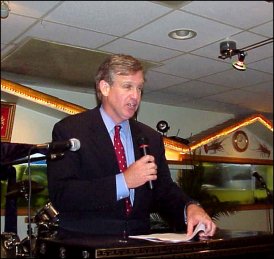
Missouri Attorney General Jay Nixon
and Maylin Mahoney, President of MABA
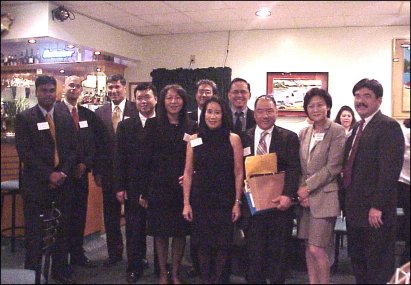
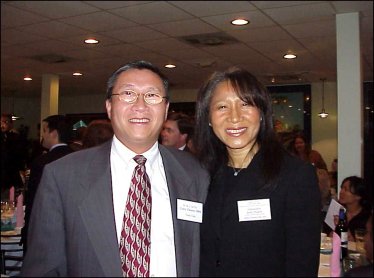
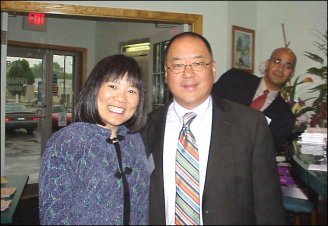
Missouri Attorney General Jay Nixon's speech at the Missouri Asian-American Bar Association 4th Annual Unity Dinner
April 22, 2004
I appreciate the opportunity to be here, and to off a few thoughts about the profession we have chosen. I am a lawyer. I take a great deal of price in that statement, and I have great respect and admiration for you and the other men and women with whom I share this profession. But these are difficult times for lawyers. You cannot turn on the television, or pick up a magazine, or browse the internet without being bombarded with lawyer jokes. You have all heard them: What do you call 10,000 lawyers at the bottom of the ocean? Answer: A good start. Why does New York have so many lawyers and New Jersey have so many toxic waste dumps? Answer: New Jersey got first choice. What do you get if you send The Godfather to law school? Answer: An offer you can't understand.
Some of these jokes are funny, most are not. None of these jokes reflects well on the profession that we have chosen. It's important to realize that the practice of law has not always been the whipping post that it is today. In fact, this is a fairly new phenomenon. If you have a parent who is a lawyer, as I do, ask them. They'll tell you that when they first became lawyers, they did not automatically become the butt of society's jokes. The legal profession has taken a lot of damage in recent years - much of it self-inflicted - and it is up to us to restore the public's confidence in, and respect for, all of us.
Anytime someone is ranting about how terrible lawyers are, you can bet it won't be long before they quote Shakespeare: "The first thing we do, let's kill all the lawyers." This phrase, taken from Shakespeare's Henry the VI, Part 2, has become the battle cry for those who despise lawyers and what we do. But those who mindlessly repeat this mantra need to pay a little more attention to the Bard and what he was saying. Let me set the stage for you: Henry the VI takes place during the War of Roses, when the Duke of York sought to oust the weak and bookish King Henry. The Duke of York hired Jack Cade, a vicious low-life, to help overthrow the King. York's plan was to have Cade go to London, make a bogus claim that he was the true heir to the throne, and incite the rabble of London to riot. Then, under cover of the riot, Cade was to set fire to London to distract and harass King Henry. Jack Cade roused the London rabble with promises that sound reminiscent of every modern-day dictator from Hitler to Mao to Hussein.
First, Cade promised that meat and cheese would be free, and 3-penny loaves would sell for a penny and a half. Second, he promised that the wealthy would be stripped of their property, and that all men would be equal and subject only to the King. Finally, Cade promised that he would fill the City's streams with free wine for all to drink. During Cade's speech, he is interrupted with the famous catcall: "First thing we do, let's kill all lawyers."
So, there it is. Today's rallying cry against the legal profession originally came from a street mob that had been whipped up by a con-man and ex-convict who was sent to overthrow the government. Immediately after this famous line, Jack Cade executed a man for knowing how to read and write. He did it because Jack Cade - and Shakespeare - knew well what many 20th century tyrants have proved: Education is the mother of liberty, and lawyers are its midwives.
Now, I'm not suggesting that we can stem the tide of public ridicule of lawyers by lecturing people about Shakespeare. You can try, but I doubt you will have any luck. No, if you are to change the way that lawyers are perceived in this country, you must do it by changing the way that lawyers act. The Preamble to the Missouri Rules of Professional Conduct highlights the three critical roles that lawyers play in our society; each of them equally important. The Preamble states that "A lawyer is a representative of clients, an officer of the legal system, and a public citizen having special responsibility for the quality of justice." Over the past decades, our profession has fallen in short in these areas, and I am asking you to re-dedicate yourselves and your careers to reversing this trend.
Always represent your clients in a way that preserves not only their rights, but their dignity as well. When you do this, you preserve your own dignity and that of your profession. Understand that the law is not a "zero-sum" game. Protecting the rights of your client does not have to mean infringing the rights of someone else. Good lawyers fight their clients' battles with tireless energy - but great lawyers find ways for their clients to avoid problems, or find creative solutions to those problems that avoid the need for a fight. As an officer of the legal system, you have an ethical obligation to treat every member of the system with respect - genuine respect that comes from the belief that, together, we all serve the common goals of justice, fairness, and equality.
More than any other single factor, the almost total breakdown in civility between and among lawyers has contributed to the public's loss of confidence in, and regard for, lawyers. Is it any wonder that the public derides lawyers when we so often deride each other? On this point, we should follow Shakespeare's advice. In The Taming of the Shrew, the Bard tells us: "Do as adversaries do at law - strive mightily, but eat and drink as friends." Finally, and most importantly, as lawyers we have a special responsibility to our communities. Our legal training has prepared us to appreciate the complexity of the issues and challenges that face our society. But our experiences have taught us that, on all of the truly difficult questions in our world, there are always at least two sides - each with merit and each supported by good men and women who are genuinely convinced that they are right. That is why lawyers know that justice is best symbolized by a pair of scales - not a light switch - and that the truth almost always lies somewhere between the extremes.
Because of your training, your talents, and your experience, many of you have already been asked to play a leadership in governance, whether it be in your social organization, your house of worship, your community, or your state. It has been said that lawyers are uniquely suited to the delicate three-cornered dance of policy, politics and principle. I believe that is true, and when term limits brought more than 100 new faces to the Missouri General Assembly in January 2003, the first question I asked was not who the Democrats or Republicans were, but instead who the Lawyers were.
I knew I could expect these men and women, from both sides of the aisle, to evaluate issues carefully and honestly. When we are called to lead, at whatever level and in whatever capacity, we must meet this challenge, and never break faith with the honor and principles that are the heart of being a lawyer.
Let me close with a story that I hope is familiar to most of you.
It was a sweltering summer day in 1935 in Alabama. A lawyer was finishing a hard day's work. At great risk to his family, his reputation, and his future livelihood, this lawyer had taken on a very unpopular client. He did it for the only reason that any of you should ever take on a client. He did it because his client needed a lawyer; his client needed someone to stand up for him and for his rights under law. The lawyer had done his best, under terrible conditions. His client was an African American who stood accused of raping a White woman. Neither the facts nor the law supported the charge, and the lawyer had patiently and carefully explained this to the jury. The lawyer begged the jury to set aside their prejudice and fear, and to serve the law. In some of the most stirring words ever written about our profession, this is what the lawyer said: "Thomas Jefferson once said that all men are created equal. There's a tendency for certain people to use this phrase out of context to satisfy all conditions. We know that all men are not created equal in all things. Some people are smarter than others. Some people have more opportunity because they are born with it. Some make more money that others and some make better cakes than others. Some people are born gifted beyond the normal scope of most men."
"But there is one place in this country, one institution, in which all people are created equal. There is one human institution that makes a pauper the equal of the Rockefeller, the stupid man the equal of the Einstein, the ignorant man the equal of any college president. That institution, gentlemen of the jury, is a court. It can be the Supreme Court of the United States or the humblest JP court in the land or in this honorable court in which you serve. Our courts have their faults, as does any human institution, but in this country, our courts are the great levelers. In our country, all men are created equal in the courts."
Well, this wondering closing argument didn't work. Prejudice won out over justice that day, and it was neither the first nor the last time. The lawyer failed, just as all of fail from time to time when we choose to fights the fights that need fighting. But he knew that, as a lawyer, he had no choice. He was bound to serve the interests of justice and his client as well as he could. The lawyer listened to the jury's guilty verdict in sorrow, and silently packed up his books and papers. He comforted his client, and talked to the court reporter about the transcript he would need for the appeal. Then he started to walk out of the crowded, but silent, courtroom. Surely you know by now that the lawyer was Atticus Finch, and his story is told in To Kill A Mockingbird. As Atticus walked out of the courtroom, this is how it looked to his daughter, Scout, who was sitting in the segregated section in the balcony: "Someone was punching me but I was reluctant to take my eyes from the people below us and from the image of my father's lonely walk down the aisle. "Miss Jean Louise?" I looked around. They were standing all around the balcony on the opposite wall. Blacks were getting to their feet. Reverend Sykes' voice was as distant as Judge Taylor's. "Miss Jean Louise," he said, "stand up. Your father's passin."
We must work hard to serve our clients well. We must work hard to serve our profession well. And we must work hard to serve our communities well. If we do, if we work hard enough, someday when we are through, they won't be telling jokes. Instead, people will say, "Stand up. A lawyer's passin."
Thank you.
|