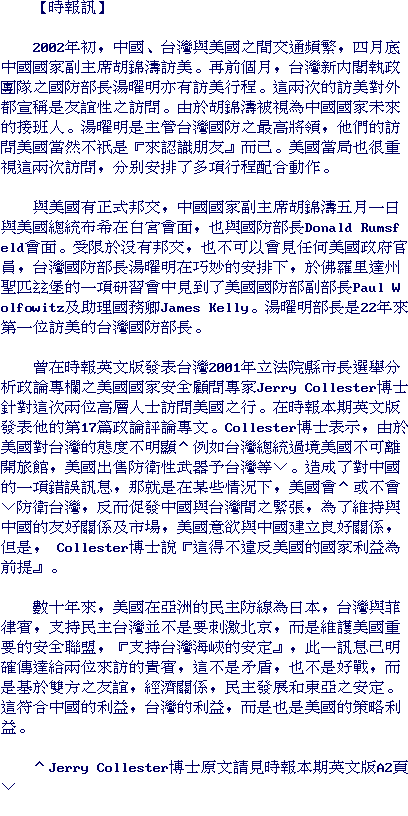
Supporters of Vice President of China Hu Jintao cross 16th Street a few blocks from the White House, walking toward the hotel where Hu will give a speech about "enhanced mutual understanding and trust towards a constructive and cooperative" China-U.S. relationship, Wednesday, May 1, 2002, in Washington. The protesters countered a demonstration against Chinese control of Tibet. The banner reads "Welcome Vice President Hu."(AP Photo/Kenneth Lambert)
By
Dr. J. Bryan Collester
Hu Jintao, the PRC's vice president and heir apparent to President Jiang Zemin came calling on the Bush administration in late April. It was styled a "get acquainted visit," minus the 10-gallon hats like Deng Xiaoping sported or visits to the presidential ranch. Even so, Western journalists sifted so little substance that some writers began using tag lines like: "Who's Hu?"
Just a month before Taiwan's new Minister of National Defense Tang Yiau-ming came calling as well. And his visit might also have been called a "get acquainted" opportunity, since he had just been appointed to the reshuffled cabinet headed by Premier Yu Shyi-kun just a couple months before, following President Chen Shui-bian's stunning legislative election victory last December 1.
As the dust settles on the two visits, pundits are speculating about whose "get acquainted" visit was more significant for the iron triangle of U.S., China (PRC) and Taiwan (ROC) interests. Even before the respective arrivals of the two high-ranking officials from the PRC and ROC, however, Hu Jintao's pending visit was greeted with considerable anticipation by analysts and acolytes alike. This was the mainland's future leader, the next putative head of the Communist party. Tang Yiau-ming's visit in March to St. Petersburg, Florida, on the other hand was greeted with muted curiosity. He was not supposed even to meet with U.S. officials, according to diplomatic understandings between the U.S. and the PRC. But he did.
Using an artful contrivance, Tang met with U.S. Deputy Defense Secretary Paul Wolfowitz at the tightly controlled U.S.-Taiwan Business Council convention in St. Petersburg. Assistant Secretary of State James Kelly also gave an address to the business group, and the State Department acknowledged U.S. officials might meet Tang, "since they were both [attending] the conference." Secretary Wolfowitz, who is deeply committed to supporting democratic development, was a natural ally to meet with Taiwan's minister of defense. Significantly the Taipei Times characterized the discussions as "the highest-level meeting between ROC and US defense officials since the two countries severed diplomatic relations in 1979."
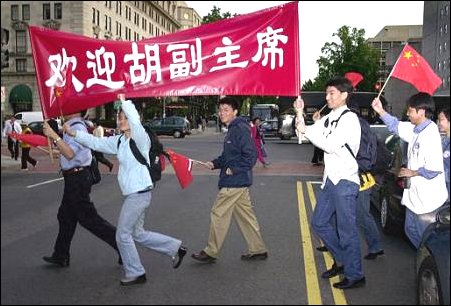
U.S. President George W. Bush greets Chinese Vice President Hu Jintao in the Oval Office of the White House May 1, 2002. Hu met earlier in the day with U.S. Secretary of Defense Donald Rumsfeld. REUTERS/Win McNamee
In the aftermath of the unheralded visits of these 2 leaders from opposite sides of the Taiwan Strait, we can see what appears to be a perceptible shift in the administration's policy toward both Taiwan and the PRC--and despite National Security Advisor Condoleezza Rice's denials that U.S. policy has changed. Or, maybe Dr. Rice really meant the goals of U.S. policy towards mainland China have not changed - and she just neglected to mention the change in the approach. Certainly the goals the United States seeks in its relationship with the PRC: expanded economic relations and amicable political relations as well as stable security relations are decades old. And, of course, the U.S. continues to encourage the development of democratic institutions and eschews the widely reported human rights' violations.
Still the U.S. approach to relations with the PRC and thus Taiwan is in apparent transition. And the administration argues this change is in the United State's own national interest. Simply put, although the U.S. wants amicable relations with China, it sees China's encroachment on and threats to control the sea-lanes-of-communication (SLOCs) in the Taiwan Strait and beyond a serious breach of the U.S.'s own presence in the Asia-Pacific. The list of strategic challenges goes on. China's challenge to the right of the United States to gather information on China's military buildup and the holding of hostage U.S. military personnel (following the Chinese F8 jet and the U.S. EP3 reconnaissance plane collision in April of 2001), plus the continued addition of 50 or more ballistic missiles (M9's and M11's) each year to threaten the Taiwan Strait, are causing warning lights to flash excitedly in the Pentagon.
Taiwan is, of course the linchpin for the United States in this security arc between Japan and the Philippines, as it has been for decades. Perhaps unintentionally, some previous U.S. administrations using the cover of "strategic ambiguity" may have appeared to "favor" mainland China because of rosy business opportunities. Even symbolic support for Taiwan was sometimes tepid. For example the president was refused permission to leave his hotel on a visit to the United States, and the sale of assets Taiwan needs to defend herself (according to the Taiwan Relations Act) were severely curtailed. Such actions, many believe, may have sent the mainland a wrong or confusing message. That wrong message was: the U.S. may (or may not) defend Taiwan, and only under limited circumstances in any case. Some defense analysts in both Taiwan and in the United States now fear such an erroneous message might even encourage the PRC to recklessly consider trying to invade Taiwan. They cite as proof that the mainland continues to maintain the right to forcibly "repatriate" Taiwan.

With the flags of the United States and the People's Republic of China hanging behind him, Chinese Vice President Hu Jintao addresses the attendees of a banquet hosted in his honor by San Francisco Mayor Wille Brown in San Francisco May 3, 2002. Hu stopped in San Francisco on his way back to China as he winds up his visit to the U.S. REUTERS/Lou Dematteis
So what is the U.S. policy-in-transition towards Beijing? It is a willingness to say to Beijing unambiguously, the United States wants good relations with the PRC and will work for them, but if you, China, act in ways contrary to U.S. national interest, then the U.S. must respond.
Unfortunately the evolving U.S. policy of "friendship-with-caution" still does not seem clear to China. For its part, the PRC repeatedly says U.S. support for Taiwan will bring hostile reactions from China. Vice President Hu reiterated this mantra. But the mainland seems to miss the U.S. administration's larger point. It is not just Taiwan, which U.S. policy seeks to befriend. It is the United States' own national security which is at risk. Therefore the U.S. will support democratic Taiwan because it is a vital security ally, not because the U.S. seeks to challenge Beijing's rightful place in the world community.
So while the U.S. abides by the covenants determining U.S.-PRC relations, like the Taiwan Relations Act and 3
communiqués, it still finds it necessary to actively involve Taiwan in U.S. security. These issues are inseparable.
By meeting with the PRC's Vice President Hu Jintao, the administration was sending a greeting of friendship and hope for improving relations in the future. And by meeting with Taiwan's Minister of National Defense Tang Yiau-ming, the administration also was sending a message of U.S. friendship and support for stability in the Taiwan Strait and SLOCs around it.
These messages are not contradictory; they are not bellicose. They are based on a desire for a mutually beneficial friendship, evolving economic relations, the development of democracy, and stability in East Asia. That policy is in China's interest. It is in Taiwan's interest, and it is also in the strategic interest of the United States.
Wednesday, May 15, 2002
J. Bryan Collester
Maybeck Place
Elsah, IL 62028
|